
 Islands Around
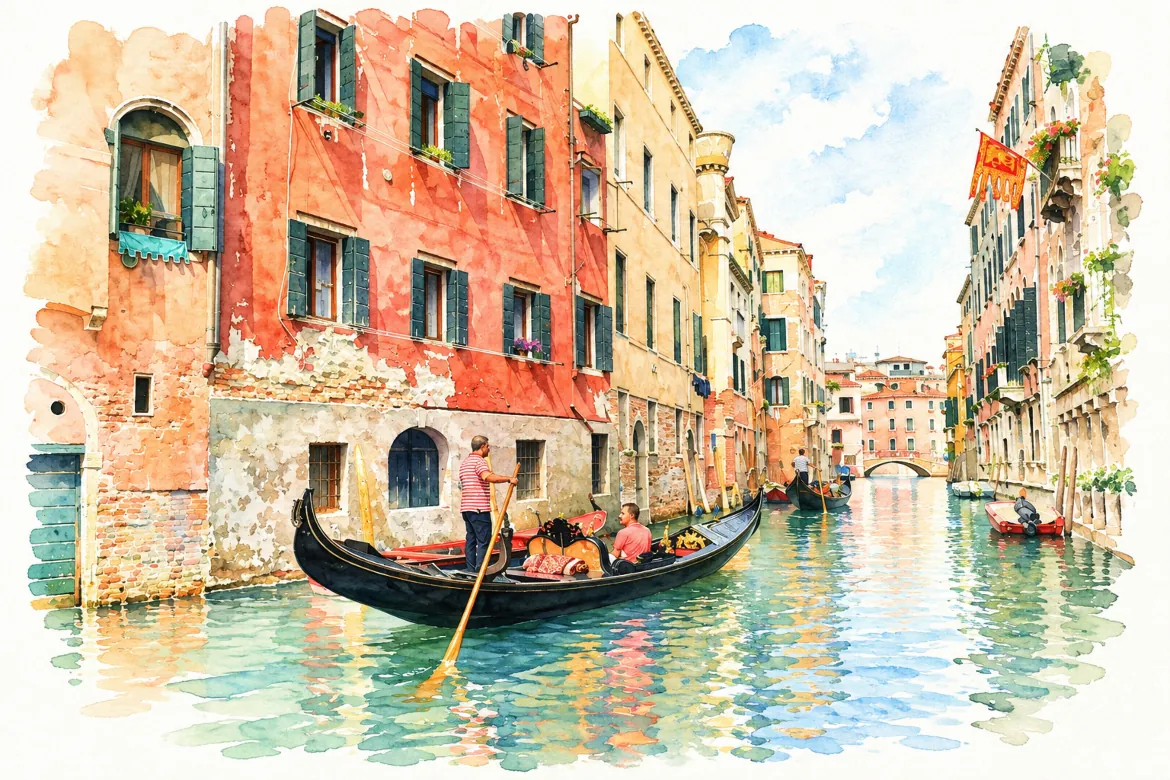
In the canals of Venice, one rower moves a gondola. He stands at the back of the boat and rows with a single long oar. Because the push always comes from the same side, the gondola should drift off course. Yet a gondolier keeps a straight line with just a few strokes, and the reason is the shape of the boat.
This page may contain affiliate links.
Why the gondola hull is not symmetrical
The left side of a gondola is wider than the right. Its keel also curves slightly to the right. The gondolier stands on the left-hand side, near the stern, and rows with a single oar resting on the right-hand side. Normally, this would pull the gondola to the left.
However, the asymmetrical shape helps counteract the turning effect of rowing on one side. Because of this, the gondola can move in a fairly straight line, and the gondolier only needs to change the angle of the oar to steer.
The forcola: the oar’s rest on a gondola
The oar sits in a carved wooden support called a forcola. It has several curves, and each curve gives the oar a different position for forward, backward, slow or turning movements. Since a good forcola fits the rower who uses it, a gondolier may spend a lot of time choosing one.
Why a gondola is black and has a steel prow
Gondolas are traditionally painted black. People often link the dark colour to a sumptuary law of the 16th century, which limited decoration and luxury on boats. The metal piece at the front, called the ferro, helps balance the gondolier’s weight at the stern.
According to a well-known explanation, the six teeth on the front of the ferro represent the six districts of the old city. Likewise, tradition says that one tooth on the back of the ferro, pointing backward, stands for the island of Giudecca.
A boatyard where gondolas are still built
The Squero di San Trovaso, in the Dorsoduro district, builds and repairs gondolas. It dates from the 17th century. Its wooden buildings look like alpine houses, with a sloping roof and a long balcony, because the first boatbuilders came from the Cadore region in the Dolomites.
You can see the yard from the canal side. There, boatbuilders work on the hulls on wooden supports on the ground. They use heat and steam to shape the planks.
Gondolas as the taxis of old Venice
In past centuries, gondolas worked as the city’s taxis, and there were far more of them than today. Now, however, a gondolier needs a licence and must pass an exam.
Special gondolas called traghetti ferry passengers across the Grand Canal at designated crossing points. Usually, two gondoliers row the traghetti. Passengers often stand during the short journey, and for this reason the fare is much lower than that of a tourist gondola ride.