
 Islands Around
Torcello is a flat, green place in the Venetian lagoon, and only a few people live there today. It is quiet enough to hear birds and the distant sound of boat engines. Yet in the Middle Ages, Torcello was one of the most important places in the lagoon, with a large population, markets and churches.
This page may contain affiliate links.
People who came by boat
When armies and invaders moved through northern Italy after the fall of the Roman Empire, people from the mainland settled in the lagoon. Invaders found the islands difficult to attack, and fishing and salt production gave the settlers a living. Torcello grew into a trading town, and its cathedral dates from the year 639.
A cathedral covered in gold
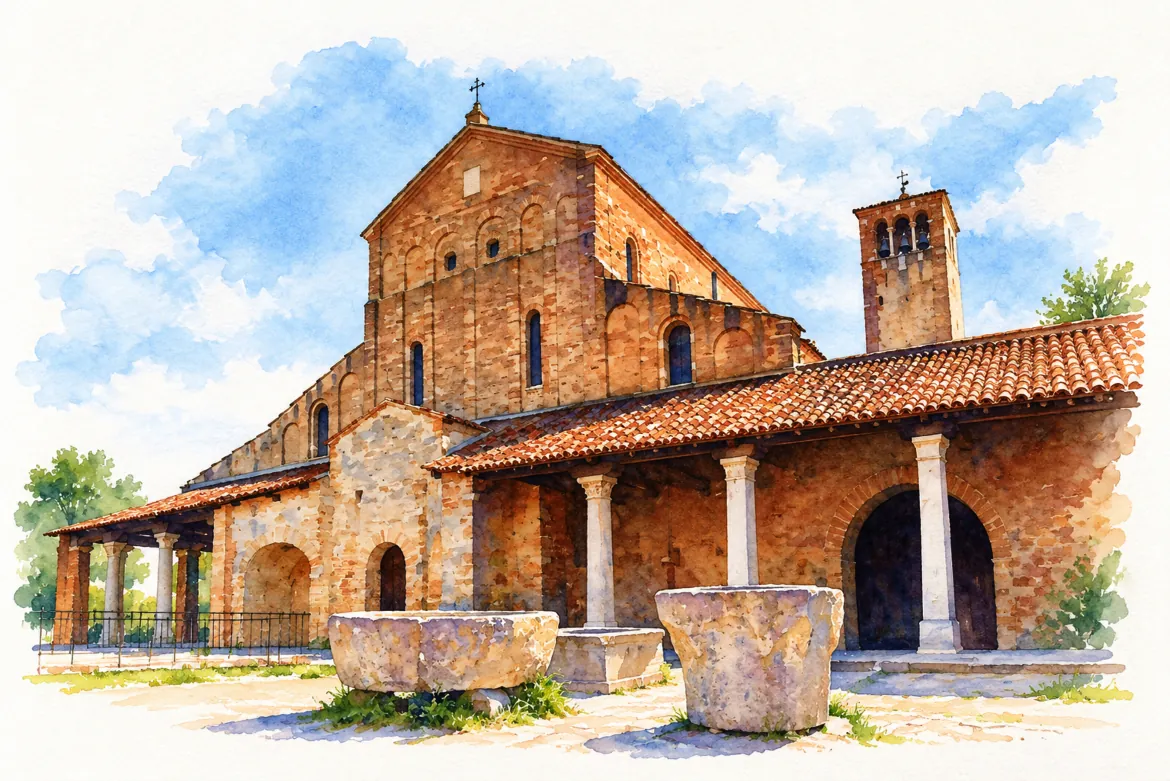
Builders rebuilt the Cathedral of Santa Maria Assunta in the year 1008, and some parts of the building are older.
Inside, the mosaics are the main reason to visit. On the west wall, a large mosaic shows the Last Judgement, with scenes of heaven and hell in horizontal bands. In the apse, a gold mosaic shows the Virgin Mary standing alone against a golden background.
These works come from the 11th to 13th centuries, and the craftsmen who made them followed Byzantine art.
The stone chair of Torcello
In the open space in front of the cathedral stands a heavy stone seat. People call it Attila’s Throne, after the leader of the Huns, but nothing proves that he ever sat on it. It may have been a seat for local officials.
Next to the cathedral stands the small church of Santa Fosca, which has a simple, balanced shape and a covered walkway around it.
Why the town faded
Torcello’s decline came slowly. Silt from rivers filled the nearby channels and turned parts of the lagoon into marshes. Standing water increased the danger of malaria, and people left for Venice, where trade was growing.
Over time, builders took many of Torcello’s old buildings apart and used the stone elsewhere.
A bridge without railings
Close to the main path, the Devil’s Bridge crosses a small canal. It is a plain brick bridge with no parapet, a style that was common in the lagoon. Take a moment to look at the brickwork and imagine how people crossed it for centuries without anything to hold on to. It is a quick stop, but one of the most photographed spots on the island.
A view from the bell tower
You can climb the bell tower of Torcello’s cathedral for a view of the marshes, the canals and the other islands of the lagoon. The climb is gradual, and at the top you see how flat and watery the landscape is, which helps you understand why the town was built here. Visit in the morning for the clearest light.