
 Islands Around
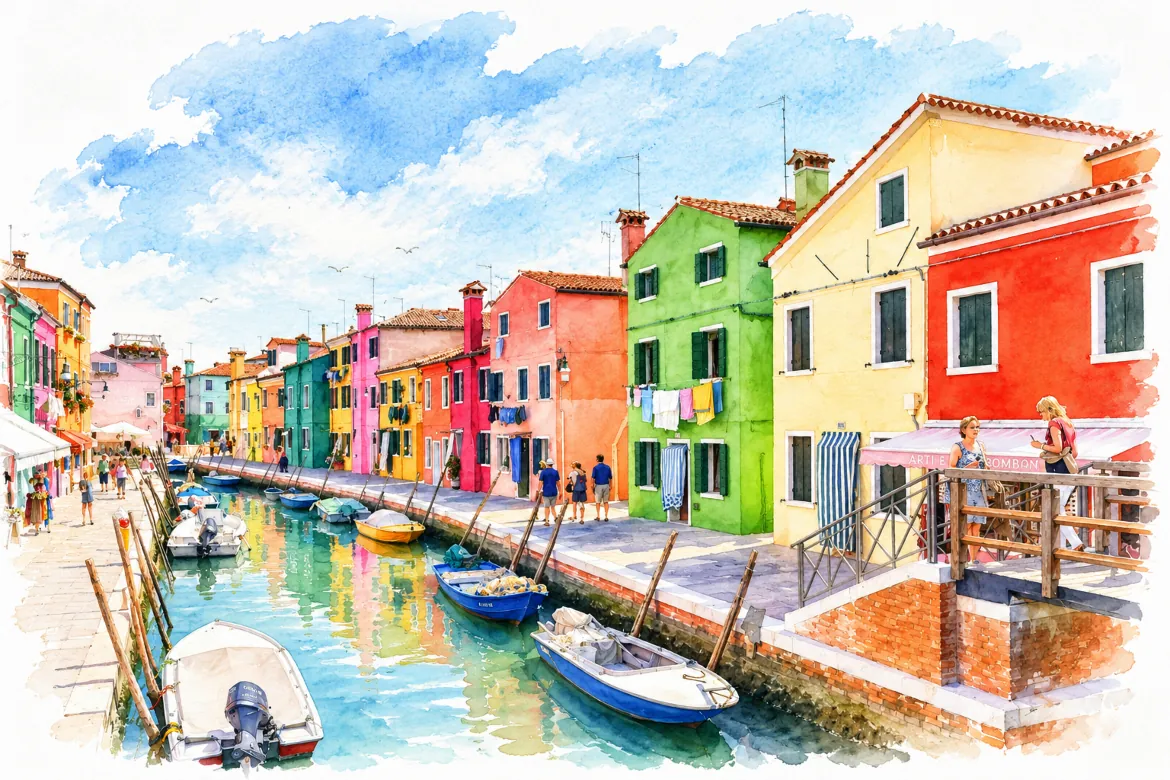
Burano, a small Italian island, lies in the north of the Venetian lagoon. Its houses are bright red, yellow, blue, green and pink. Neighbouring houses usually have different shades, and the water of the narrow canals reflects them.
The ferry between Venice San Marco and Burano takes about 45 minutes, so you can easily visit the island in a day.
This page may contain affiliate links.
The fishing history of Burano island
For centuries, Burano was a fishing community. The men sailed out into the lagoon and the Adriatic Sea, while many women worked at home. Lace gave them a skilled trade and a second income for the household. Therefore, it became the island’s other famous craft.
A story about fog
A well-known explanation says that fishermen painted their houses in bright shades so they could see them through the fog on their way home. It is a pleasant story, but nobody has proved it.
Other explanations are just as plausible: fishermen may have used leftover boat paint, or families may have wanted their homes to stand out. Whatever the reason, the tradition survived.
Today the municipality protects the colours. Owners reportedly must ask for permission before repainting and choose from an approved scheme. Visitors come to photograph the result.
Needle lace on Burano island
Burano’s lace is needle lace. The lacemaker uses a single needle and thread and makes thousands of tiny stitches, one at a time, following a drawing on paper. The craft became important on the island in the 16th century. It later declined, so the island opened a lace school at the end of the 19th century to revive it.
The Lace Museum occupies the old school building on the main square. Inside, you can see old pieces and learn how long a small piece of lace takes to make.
However, some lace in the shops is not handmade on the island. Therefore, ask where a piece was made, and be wary of very low prices.
A leaning tower and a famous composer
The bell tower of the church of San Martino stands near the Lace Museum. It leans noticeably to one side because the ground under it is soft.
The square in front of the museum carries the name of Baldassare Galuppi. He was a native of Burano and became a leading figure of Venetian music in the 18th century.
Bussolai, the biscuits of Burano
Burano also has its own biscuit, the bussolai. These dry butter biscuits often have an S shape, though rings are common too. Local bakeries sell them in paper bags, and they keep well for a good while.