
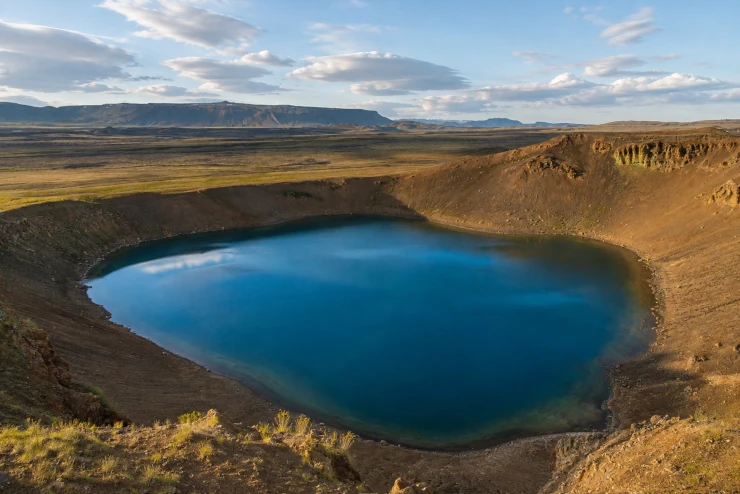
Víti in Krafla is a volcanic crater in northern Iceland, close to Lake Mývatn. Its name means “hell” in Icelandic, which shows how powerful and violent its formation must have looked to the people who first saw it.
The crater formed in 1724, at the very start of a period of volcanic activity called the Mývatn Fires, which continued on and off for about five years.
Víti is what geologists call an explosion crater. It formed when rising magma came into contact with underground water, causing a sudden, powerful blast of steam that blew out a wide, round hole in the ground. The crater measures about 300 meters across.
Inside the crater sits a lake with striking turquoise blue water. The color changes slightly depending on the light and the minerals dissolved in the water, which rise up from below the surface through geothermal activity. This is common near active volcanoes, where mineral-rich water gives lakes their unusual colors.
For more than a hundred years after the eruption, the crater floor stayed hot and the water inside kept bubbling.
Víti sits within the larger Krafla volcanic area, a long stretch of active volcanic ground running along the Mid-Atlantic Ridge. This ridge marks the place where the North American and Eurasian tectonic plates slowly move apart, which is one of the main reasons Iceland has so much volcanic and geothermal activity.
Krafla itself has produced more than twenty eruptions since people first settled in Iceland, making it one of the more active systems in the country, alongside volcanoes like Hekla and Katla.
Despite this ongoing activity, the area is closely watched by scientists, and it is considered safe to visit under normal conditions.
Still, since the ground near geothermal sites can look solid while actually being fragile, it is best to stay on marked paths and keep some distance from the crater rim, where loose gravel can make footing unsteady.
A paved road leads to Víti from the main road nearby, making it an easy stop when exploring the Mývatn area. The site is most accessible in summer, when snow and ice are gone and the paths around the crater rim are clear for walking.
Beyond geology, Víti has also left a mark on Icelandic culture. The poet Jónas Hallgrímsson wrote a poem named after the crater, later set to music by composer Jón Leifs.
This shows how a place shaped purely by underground forces and steam explosions can still find its way into art and memory, long after the ground itself has cooled and settled into quiet blue water.
This page contains affiliate links, which may earn us a small commission at no extra cost to you.