
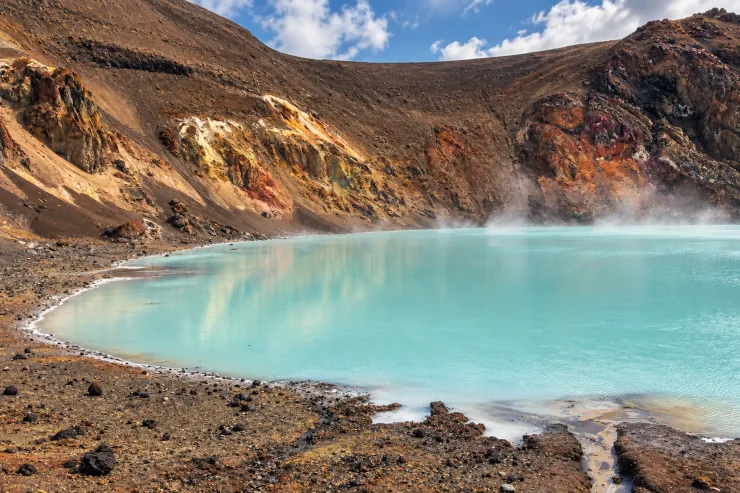
Víti is a small crater lake sitting right next to the much bigger Öskjuvatn, inside the Askja caldera in the Highlands of Iceland. Its name means “hell” in Icelandic, which gives you an idea of how it looked when it formed.
Both craters were made in the same event: the big 1875 eruption, one of the strongest ash eruptions in the country’s history. Víti itself was probably made by a steam explosion, when hot magma met groundwater and the pressure blew a hole in the ground.
The crater is small compared to its neighbor, only around 100 to 150 meters across, and the water is about 8 meters deep.
What makes Víti different from Öskjuvatn is the temperature. While the big lake is too cold for swimming, Víti stays warm, usually somewhere between 20 and 30°C, because heat from old magma below still reaches the water. This is why so many people want to get in.
The water carries a lot of sulfur, so you may notice the smell before you even see the crater. A ring of loose volcanic rock, called a pumice cone, surrounds the crater and gives it its shape.
The wider Askja area was shaped over a long period of geological history. At the end of the last Ice Age, a magma chamber below the Dyngjufjöll mountains emptied out and the ground above it sank, creating a much larger depression around 50 square kilometers wide.
The 1875 eruption then formed a smaller caldera inside that older one, along with a huge amount of tephra, the colored volcanic ash that still covers the ground today and gives the region its unusual look. This ash traveled far beyond Iceland; some reports say it reached mainland Europe within two days.
Askja lies on a long line of volcanic activity called a fissure system, one of the most active in Iceland, stretching from a glacier in the south down toward the coast.
The system has produced dozens of eruptions in the last two centuries, including a series in the 1980s and smaller events earlier in the 20th century. Because of this, the ground around Víti and Öskjuvatn keeps slowly changing shape, and small earthquakes are still common in the area.
Getting close to Víti means walking along a steep and often slippery path down into the crater. The ground near the rim is loose and can be unstable, so it needs care.
Once at the water, be aware that sulfur fumes can be strong in some parts of the crater, and the mud along the eastern edge can get very hot. This is still an active volcanic system resting quietly for now, not a finished or dead landscape.
This page contains affiliate links, which may earn us a small commission at no extra cost to you.