
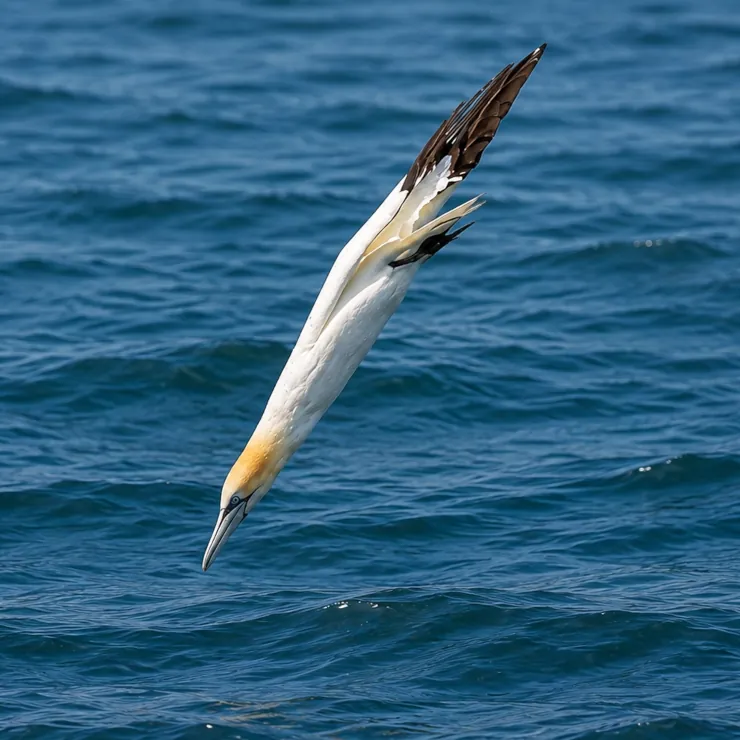
Most birds that hunt fish do so by walking through shallow water or skimming the surface. The Northern gannet does something much more extreme. It sees a fish from high in the sky. Then it pulls its wings close to its body and dives straight down, sometimes hitting the water at speeds of up to 100 km/h. The fish has very little chance of escaping.
The bird’s body is made for this kind of hit. The Northern gannet’s nostrils are inside its bill, not exposed like most birds’, and it can close them before a dive. It also has a spongy bone plate at the base of its bill that helps it withstand the impact. Under its skin, in its lower body, along its sides, and between its ribs and chest muscles, there are small air sacs. They are connected to its lungs and may help control its buoyancy underwater.
Once under the water, the gannet’s first dive usually takes it about 11 meters down, but it often swims on to an average depth of around 20 meters, sometimes deeper than 25. Often, the bird catches its fish while swimming back up, not while going down.
Gannets rarely hunt alone. When one bird finds a group of fish, other birds quickly notice and come to join. Soon many gannets are diving into the water nearby, again and again. Some birds from colonies like Scotland’s Bass Rock fly far out to sea to find fish, sometimes as far as Dogger Bank, nearly 300 km away.
The Northern gannet looks calm and graceful while flying. But the moment it begins its dive, its whole body works like a machine built for one job: to catch the fish before it swims away.