
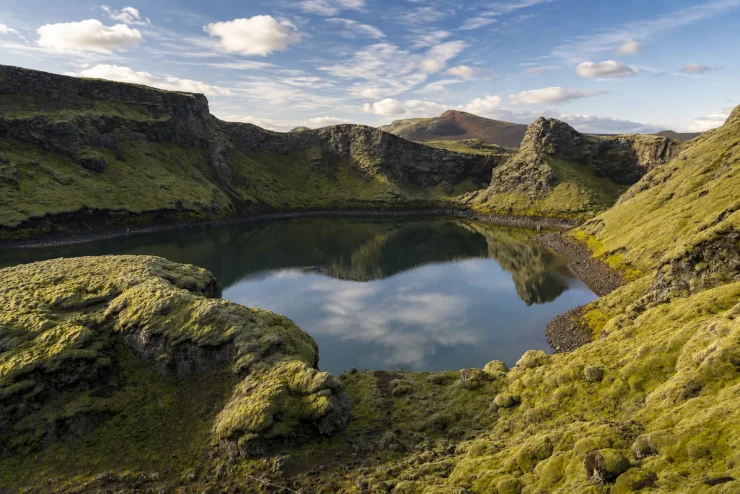
Tjarnargígur, often called Pond Crater, is one of the craters at Lakagígar, a 30-km-long row of craters in the Highlands of Iceland.
It was formed during the Laki eruption of 1783 to 1784, a huge event that also produced a long line of craters stretching about 25 kilometers across the land.
This eruption sent out enormous amounts of lava and gas, and it changed the landscape of this part of Iceland for good.
The crater itself is still young in geological terms. Because of this, the ground around it looks raw and rough, made mostly of dark lava rock.
But if you look closer, you will notice patches of bright green moss growing on the lava. This moss is important. It slowly breaks down the rock and helps soil begin to form, which lets other plants grow later. It is an early step in how life returns to a place after a big eruption.
What makes Tjarnargígur stand out from the other craters at Lakagígar is the small pond sitting inside it.
The water is very clear, and because the pond is narrow and about 12 meters deep, it often looks bright turquoise on a sunny day. This color, together with the dark lava around it, makes the crater one of the most photogenic spots in the whole area.
Lakagígar sits deep in the Highlands, so it can only be reached part of the year, usually from late June or early July once the mountain road dries out after winter snow.
The road there is rough, crosses several rivers, and needs a 4×4 vehicle. Because of the difficult driving conditions, reaching Tjarnargígur takes patience and careful planning.
Near the crater, there is a parking area with space to rest, and two walking paths lead from there. One goes to the pond itself, and the other, a bit longer, leads through the surrounding lava field. Both paths pass through a quiet, mossy landscape that feels far removed from ordinary life, shaped entirely by fire and time.
Tjarnargígur is a good example of how a single eruption can leave behind many different features across a wide area, not just one crater but a whole chain of them, each slightly different depending on how the lava and gas moved through the ground.
Visiting places like this helps us understand how Iceland’s landscape keeps forming, one eruption at a time, and how nature slowly reclaims even the harshest volcanic ground.
This page contains affiliate links, which may earn us a small commission at no extra cost to you.