
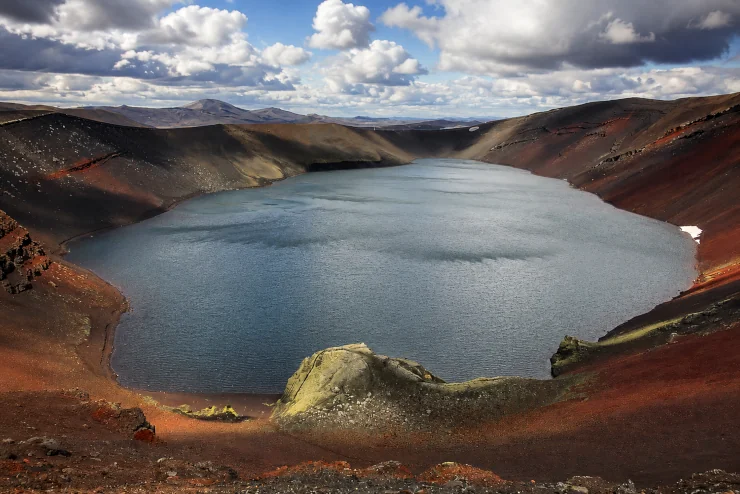
Ljótipollur means “Ugly Pond” in Icelandic, but the name is misleading. This crater lake in the Highlands of Iceland is actually one of the most colorful and photogenic places in the area.
Formed during an eruption in 1477, it sits northeast of Frostastaðavatn, a lake that is part of the Veiðivötn volcanic fissure system.
The crater is a type of volcano called a maar. This forms when hot magma meets groundwater underground, causing a strong explosion that blasts out a wide, round hole without building up a large mountain.
That is why Ljótipollur looks like a deep bowl cut straight into the ground, with steep walls rising 70 to 120 meters around a lake below.
The lake itself covers about 0.45 square kilometers and reaches a depth of around 14 meters. There is no river flowing in or out, so all the water comes from underground.
This makes the color especially striking, a deep turquoise blue that contrasts sharply with the red and orange volcanic rock of the crater walls and the green moss growing on the slopes. It is easy to see why photographers are drawn here.
Despite having no inlet or outlet, the lake holds brown trout, and nobody knows for certain how the fish arrived. Most weigh around half a pound, though some have been caught much larger.
Anglers have fished here for generations, and fishing reports are still collected at a nearby cabin to help track the health of the lake.
Getting down into the crater takes some care. A set of steps leads from the rim to the water on one side, and this is the only place where fishing from the bank is possible. The path can be steep and loose in spots, so good footwear helps.
A trail also runs around the top edge of the crater, giving changing views as you walk. Looking one way, you can see the sharp rhyolite mountains near Landmannalaugar.
Looking another way, braided glacial rivers stretch across the plain toward distant ice caps. Because the crater is wide, capturing the whole scene in one photo is difficult, and a wide-angle lens helps.
Ljótipollur sits along the F208 mountain road, a short distance from Landmannalaugar, and like the rest of the Highlands, it is reachable only in summer once the road opens after the spring melt.
There are no toilets or other facilities at the site, and the parking space is small, so it stays a quiet, natural spot rather than a busy one. The mismatch between its plain name and its striking colors is part of what makes a visit here memorable.
This page contains affiliate links, which may earn us a small commission at no extra cost to you.