
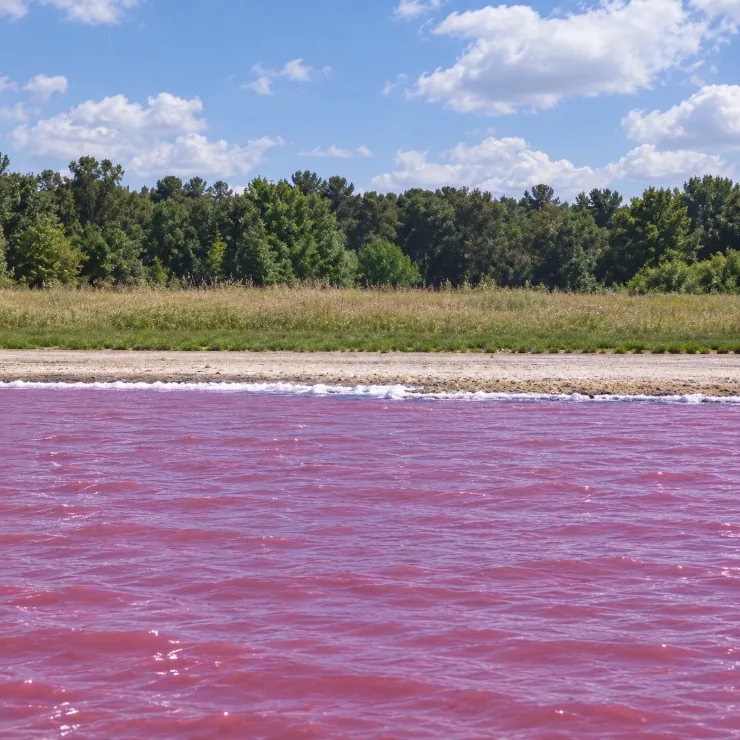
Lake Pergusa lies near the city of Enna, in the Erei Mountains of central Sicily, nearly 700 meters above sea level. Its basin is tectonic in origin, meaning it was formed by movements in the Earth’s crust. Part of the surrounding valley is covered by a forest called Selva Pergusina.
The lake has an unusual feature: its water is brackish, or slightly salty, even though it lies in the middle of the island. It has no river flowing out of it, and evaporation is the main way water leaves the lake. As the water evaporates, salts remain behind, while rain and groundwater continue to fill the lake. Scientists call a lake like this endorheic.
Sometimes the lake turns reddish-purple. This happens when red sulfur bacteria grow in large numbers under certain environmental conditions, giving the water this unusual color.
Lake Pergusa is also linked to one of the best-known Greek myths. According to the story, Persephone, the daughter of Demeter, was picking flowers near the lake when Hades, the god of the underworld, took her away and made her his wife. Demeter searched for her for days. In her grief, the goddess of the harvest neglected the earth, and the crops began to fail. In the end, Zeus decided that mother and daughter could spend part of the year together. In the myth, Demeter’s sadness while her daughter is away brings autumn and winter, while Persephone’s return brings spring and summer.
Today, the lake matters to living creatures as well, since it is a stopover on one of the main bird migration routes of the western Palearctic. In spring, little egrets, gray herons, night herons and glossy ibises appear. In winter, flocks of teal, shovelers, wigeons, pochards and coots arrive. Rare visitors such as the marsh harrier and the ferruginous duck also stop here, and the Sicilian rock partridge nests on the hills around the lake.
Yet the lake has faced serious threats. For many years, drought, higher temperatures and the use of groundwater have caused the water level to fall. In the summer of 2024, a long period without enough rain left the lake almost dry, reducing it to a very small area of water and threatening the plants and animals that depend on it.