
 Islands Around
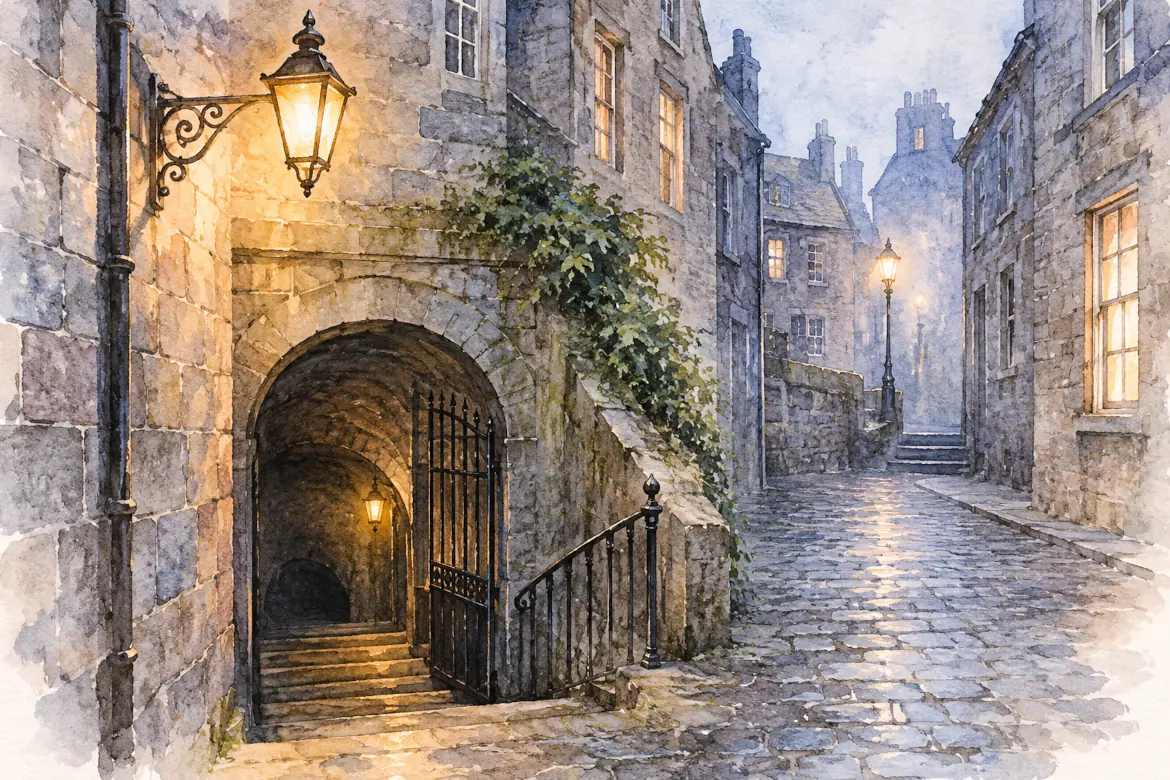
Edinburgh has always been a city of secrets. Some are hidden in old houses, others sealed beneath its narrow streets, where the dead still live by rules of their own. Down there, memories can be bought and sold, and something older than the dead listens in the dark. Few people know it. Fewer still would wish to find out.
The Three Rules
In my time, every child in Edinburgh learned three rules.
The first was simple: never knock three times.
The second was just as old. If you heard three knocks from the other side of a wall, or from beneath the floor, you were to pretend you had heard nothing. Above all, you must never knock back.
The third was never to answer when someone called your name from a place you knew to be empty.
People had repeated these rules for generations. Some said they came from the old closes, the narrow lanes off the High Street, where families lived above deep cellars and passages cut into the rock. Others claimed they were older still. Nobody knew who had made them, but most people kept them all the same, the way people touch wood for luck without quite believing in it.
I did not believe in such things. I was a watchmaker, and I preferred explanations that could be tested with a good light and the right tools.
My name is Thomas Bell. I was twenty-six years old when I died in November 1809.
That evening I was alone in my workshop, finishing the repair of a customer’s silver watch. It had a broken spring, and I had spent most of the afternoon replacing it and cleaning the wheels.
The workshop was on the ground floor of a tall old tenement building in a close off the High Street. My mother and I lived above it, in two rooms reached by a narrow staircase at the back of the workshop. Beside the foot of that staircase was a door to the cellar, which lay under the workshop floor.
It was a raw November night. Darkness had fallen by four o’clock, and by nine the close was empty. A cold sea fog had crept up from the Firth of Forth and pressed itself against the window.
My own watch lay on the bench beside my tools. It had belonged to my father, and I carried it almost everywhere. Its case was scratched, and a small crack ran across the glass. It was worth very little, but it was the only thing I had of him.
My mother had gone to bed less than an hour before. As she did almost every night, she had called down from the top of the stairs: “Mind the lamp, Thomas, and don’t sit up too late.”
Now the customer’s watch was running true again. I closed its case, laid it in a small wooden box, and set the box on the bench.
Then I went out into the close to fasten the shutter over the window. I stayed outside longer than I needed to, with the fog cold on my face, listening to the town settle for the night. When I came back in, I barred the door behind me. The workshop was exactly as I had left it. I picked up the box to put it away on its shelf.
That was when I heard a sound beneath the floor.
I stood still, holding the box. I thought something had fallen in the cellar. Then the sound came again.
Three slow knocks, with a pause between each.
I put the box down on the bench. If anyone was in the cellar, it could only be my mother, who might have come down the back stairs while I was in the close.
Then a voice spoke from beneath the floor.
“Thomas?”
It was my mother’s voice.
“Thomas, are you there? Come down.”
I stood very still. The voice was exactly hers, down to the small catch she had before certain words. But my mother hated that cellar. She never went down it after dark, and in all my life I had never heard her ask anyone else to go down it at night. That alone should have warned me.
Yet she might have gone down for some reason of her own and fallen on the steps. I went to the foot of the stairs and called up into the dark. “Mother? Are you in your room?”
Nobody answered. The upper floor was silent.
“Thomas,” said the voice from below, more faintly. “Please.”
I turned to the cellar door. “Mother?”
The moment I spoke, I knew I had broken the third rule. The house went quiet, the way a room goes quiet when someone starts listening.
Three more knocks came from below.
I told myself that she might be hurt, or that a barrel had slipped against the wall. I opened the door and looked down the steps. The dark below was complete. “Mother, is that you?”
Nothing answered.
I went back to the bench and lit a candle from the lamp. My father’s watch lay beside my tools, and I put it in my waistcoat pocket, as I always did when I left the workshop. It showed twenty minutes past ten.
I returned to the open cellar door. Three knocks had come from below, and I knew the rule: I must not knock back. But I wanted proof that the sound was no trick of the old house, and the only way to test a sound is to answer it. Holding the candle in one hand, I struck the door frame three times with the other. In that one moment I broke the first rule and the second.
The sound echoed clearly through the silent house.
I waited. Nothing happened, and I felt a little foolish. I went down.
The cellar was empty. The shelves stood where they had always stood, and the old barrels were covered in dust. Then I held the candle higher and saw a woman standing by the far wall. She wore the blue gown my mother had worn at supper, and her back was to me.
“Mother?”
She turned her head slowly.
For a moment, I believed it was her. Then the candlelight moved across her face, and I saw that something was wrong. Her features shifted like a reflection in disturbed water. Behind her, the wall had vanished, and in its place a narrow tunnel ran back into darkness. Cold air came out of it, smelling of wet stone.
She held out her hand.
I stepped towards her. The candle flickered once and went out.
I remember her fingers closing around mine. Then I remember nothing.
The Passage Beneath
When I opened my eyes, I was lying on a stone floor.
I sat up. I was in a long underground passage with walls of dark stone. Small lamps burned in iron brackets along the walls. There were no windows, but the lamps gave enough light to see by.
I felt my chest and arms for injuries and found none. I remembered the cellar, the candle and the woman’s face, and nothing after that.
My father’s watch was still in my pocket. Its hands had stopped at twenty-two minutes past ten. I tried to wind it, but the crown would not turn.
A woman stood a few steps away.
“Ye’re awake,” she said.
“Where am I?”
“Below Edinburgh.”
“How did I get here?”
“Ye answered a call.”
She said it as if it were an ordinary explanation. “I’m Agnes McRae. I died in sixteen seventy-four. I’ve been here a good while.” Her speech was the old Scots of her own time, slower and softer than the Edinburgh I knew.
“Are you telling me I’m dead?”
Agnes nodded.
I stood up too quickly and almost fell. She caught my arm. “Take yer time, lad. The first day is the worst.”
“I can’t be dead. I was in my workshop.”
“Ye were. Then ye went down to the cellar.”
“How do you know that?”
“The call leaves a mark on those it takes. Folk who’ve been here long can read it.”
I looked at my hands. They were solid. I could feel the cold of the stone through my boots, and the weight of the watch against my chest.
“But I can still feel things,” I said. “If I’m dead, how?”
“Death doesnae take everything away.”
“There was cold. I felt it.”
“That was only what the call showed ye. In truth, ye died in yer own cellar, and yer body is lying there still. What woke up here is yersel.”
I asked her to show me the way back. She said the way that brought me was shut. I did not believe her. I walked along the passage to its end and found only a bricked-up archway. A side turning led to a low room with no door on the far side.
When I returned, she was waiting.
“Ye cannae go back just because ye want to,” she said.
She led me onward. We passed doorways, some open and some boarded up with old planks. Behind one, a man was talking to himself. Behind another, a child was crying. Somewhere in the wall beside us came three slow knocks. Agnes did not turn her head.
“Keep walking,” she said quietly. “Dinnae knock back.”
I kept my hand at my side.
“Is that what called me?” I whispered.
“I hope not. That’s only the old knocking, an echo left in the stone. The city has it the way old houses have draughts. I always thought it was harmless.”
I thought of the cellar door, and of my own three knocks, and said nothing.
We came to a wide chamber where several people sat around a small fire, dressed in the clothes of different centuries. An old soldier was polishing a button on his coat. A young woman was sewing. A boy sat alone against the wall.
“A new arrival,” said the soldier. He looked at me closely. “Did you hear the knocking?”
I nodded.
“Did you answer it?”
I looked at Agnes. The soldier gave a short laugh. “Then you’ll have trouble.”
“Haud yer wheesht, Duncan,” said Agnes, which means be quiet, and she led me out.
The Forgotten Child
The next day, when we passed through the chamber again, the boy was still sitting alone. He looked about ten. His coat was far too big for him, and one of his shoes was missing.
“What’s your name?” I asked.
He looked up. “I don’t know.”
Agnes sat down beside him. “His name is Robert. He died of a fever. On his last night he heard knocking under his bed. He told me so himself, back when he still remembered it. Now he only knows he had a sister, and nothing more.”
“Not even her face?”
“No. He spoke of her every day, and it grew too painful, because she had died before him. So he went to Silas Vale.”
“Who is Silas Vale?”
“A man who buys memories.”
Robert was turning a small wooden horse over in his hands.
“Where did you get that?” I asked him.
“I don’t know.”
Agnes gently took it and handed it back. “Yer sister made it for ye, wee man. Ye told me so yersel, before ye went to Silas. She carved it from a piece of wood and gave it to ye on yer birthday.”
The boy looked up, and for a moment his face changed. “What was her name?”
Agnes shook her head. “I never learned it. He only ever called her ‘my sister’. We’re trying to help ye remember it.”
When he had bent over the horse again, I said quietly, “Why would a child give up the memory of his own sister?”
“Because he couldnae bear it any longer. Silas promised to take only the pain of it, but memories are tied to one another, and he took more than Robert agreed to give.”
“Then why do people still go to him?”
“Grief is heavy, even after death. Silas knows what to say to folk who are carrying it.”
The Memory Merchant
The next day Agnes took me to meet Silas Vale. “Ye’ll meet him sooner or later,” she said. “Better with me beside ye.”
He lived in a large room at the end of a narrow passage. Shelves covered every wall, and hundreds of small glass jars stood on them in rows. Each jar held a faint light, pale blue or yellow or white.
He was a tall, thin man with carefully combed hair, and his clothes were old-fashioned but well kept. He was not from Edinburgh. Agnes told me later that he had come north from England while he was alive, and had died in the city, and had never lost the soft vowels of the south. He greeted her like an old friend.
“And this is Thomas Bell,” he said. “The watchmaker.”
Agnes had not told him my name. “How do you know it?”
“The call writes it on you.”
He offered me a chair, but I stayed standing. “What are those jars?”
“Memories.” He lifted one down. A small light moved inside it. “This one belonged to a woman who died in seventeen twenty-one. Her wedding day.”
“You took it from her?”
“She gave it to me. She could no longer bear to remember her husband. I offered to keep it safe.”
“The boy in the chamber came to you.”
“Robert asked me to remove the memory of his sister’s death. It was delicate work, and I took too much.”
“Can you give it back?”
“Not yet. The memories are tied together, and I must work slowly.”
On his desk lay a small watch with its hands stopped at seven minutes past four. A watchmaker notices such things.
“Does it work?”
“No. It was my wife’s. It stopped when she died. I was in the next room.” He lifted it carefully. “Her name was Margaret. I know I loved her. But I cannot remember what we said to each other, or the choices we made, or what it was to live beside her. In my grief, I took the memory of her face out of my mind and put it in a jar. Now I can look at that face, but the life that belonged to it is gone.”
He set the watch down.
“That is why I collect, Thomas. I believe there is a place beneath this city where the first memories of the dead are kept. If I can reach it, I may find what I have lost.”
“And how will you reach it?”
Silas looked at his shelves. “With the right memories. The memories of those the call has touched.”
He said no more. But as we left, I noticed a jar near the door, and inside it a tiny image of a boy holding a wooden horse. I did not ask him about it.
The First Silence
Over the following days, Agnes showed me the underground city. It was not one place. It had grown beneath Edinburgh over centuries, out of old cellars, forgotten rooms, streets that had been built over and sealed up, and chambers cut into the rock. Some passages ran beneath the closes of the High Street, and some under the great arches of the South Bridge. The oldest were beginning to crumble.
The dead had made homes in many of them. I saw a woman who still kept a shop, though nobody needed to buy anything. I met a man who waited every evening beside a door that had not opened in a hundred years.
There were rules here too, and I recognised some of them. People did not give their full names near the oldest passages. Nobody entered a room where three lamps had gone out. When a voice called from behind a closed door, the sensible thing was to walk away.
“Some of these are the same as the rules above,” I said.
“Aye. They came down with the folk who died. The living made them first, and the dead carried them along, the way ye’d carry a candle into a cellar.” She stopped beside a wall. “They’re not spells, Thomas. They’re warnings. The lamps go out when the knocker is near. A name is what it calls by, so we keep ours close. Long ago somebody learned what happens to those who answer, and the rules are all that’s left of what they learned.”
“Who knocks?”
“We call it the First Silence.”
I waited for her to go on.
“Nobody knows what it is. It was here before the oldest of us. It has no voice of its own. It borrows voices, the way a bell borrows a hand.”
“Why does it borrow them?”
“It hears everything said in this city, but it cannae tell one of us from another. What it can feel is a mind turning towards it, the way ye feel someone watching ye. Then it reaches into that mind and takes the voice the person trusts most, and the name it has overheard goes with it. It asks only one question: Are you there? And a trusted voice is the one that gets answered.”
“And when someone answers?”
“Then it has a thread to follow. Mark this, for it matters more than any rule. A word said to it is a door. A word said to a neighbour is a wall. If ye answer it, it knows where ye are. If ye follow it, it draws ye away from the rest of us, and after a time yer own memories begin to go.”
I searched my memory then. My mother’s face, my father’s watch, the name of my street. I found them all there. For now.
“Does it call often?”
“It has been quiet in the deep city for many years. Only a faint knock now and then, far below. We hoped it would stay so.” She frowned. “This autumn, though, I heard the old knocking in the upper stone, where it has no business. I thought it was only the echo. I was wrong.”
I thought of the cellar, and of my mother’s voice. “It called me by name.”
“Aye. And ye answered.”
“I knocked back as well.”
Agnes closed her eyes for a moment. “Aye. That I didnae want to hear.”
I thought of Silas and his jars. He needed the memories of those the call had touched, and the call had come up into the upper stone this autumn, after years of only faint knocks far below. A suspicion was beginning to form in my mind, though I could not yet put it into words.