
Forget the beaches for a moment. Deep in the Sardinian interior, where golden hills roll toward the horizon and the air smells of wild herbs, a very different kind of this second-largest island in Italy is waiting.
This page contains affiliate links, which may earn us a small commission.
In the small town of Barumini, about an hour’s drive from Cagliari, stone towers rise from the earth like something between a fortress and a riddle. This is Su Nuraxi, and it has been quietly watching over the Marmilla countryside for more than three thousand years.
Nobody can say for certain why the nuraghi were built. Were they royal homes? Watchtowers? Sacred spaces for rituals we can only imagine? Archaeologists still argue about it, and that uncertainty is part of the magic.
Standing beside the main tower, almost 20 metres of dark, weathered stone, it is easy to feel small, and a little humbled, in front of something so old and so stubbornly mysterious.
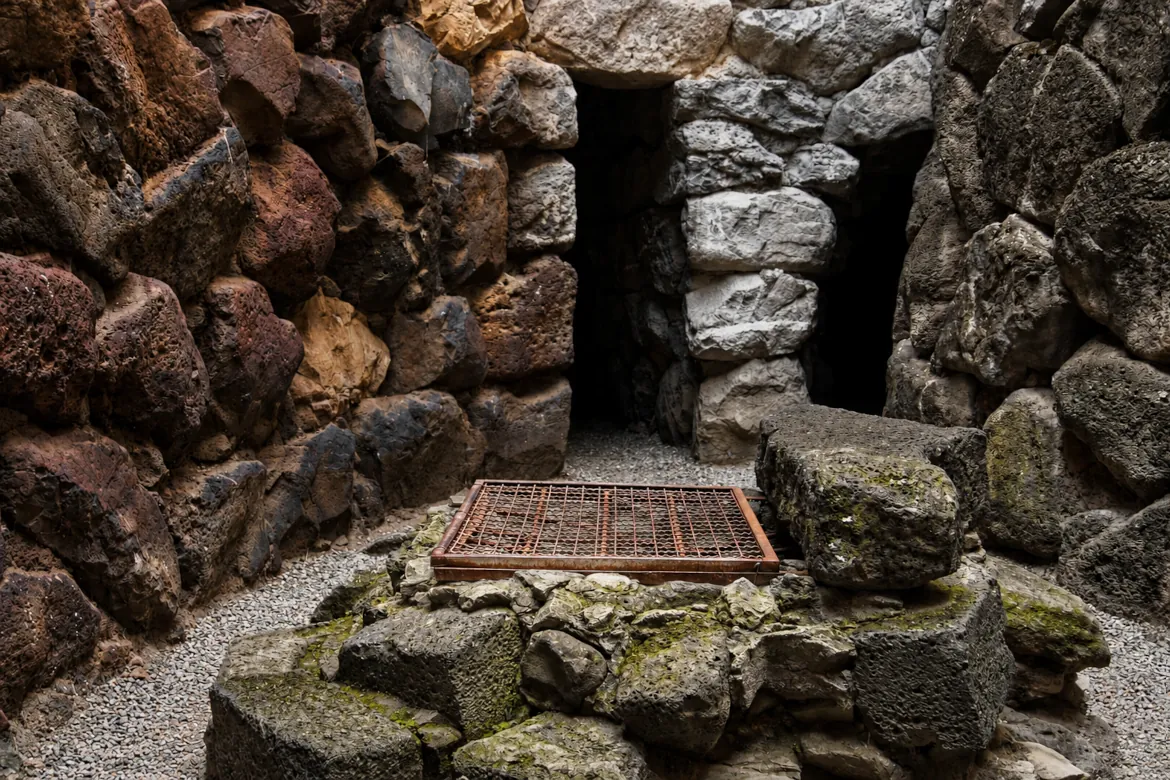
Four smaller towers surround the central one, joined by heavy walls that have survived earthquakes, wars, and thousands of Sardinian summers. In the middle of the structure sits a courtyard with a well plunging 20 metres into the ground, once the lifeline of an entire community.
Peer down into the darkness, and you can almost picture the daily rhythm of life here: water carried in clay jars, fires burning in round stone huts, voices echoing off the walls at dusk.
The original tower once held three levels stacked on top of each other, reached by a winding stone staircase built into the wall. The topmost level disappeared long ago, but the lower two have held up surprisingly well against time.
The story of this place spans an extraordinary period of time. Building work began around the second millennium BC, in the Bronze Age, and the site stayed in use well into the Iron Age, right up to the 3rd century AD. Over these centuries, the people who lived here were far from cut off from the wider world.
Traces of contact with Mycenaean traders, and later with Phoenician merchants, tell of a community that looked outward, exchanging goods and ideas across the Mediterranean long before written history began on the island.
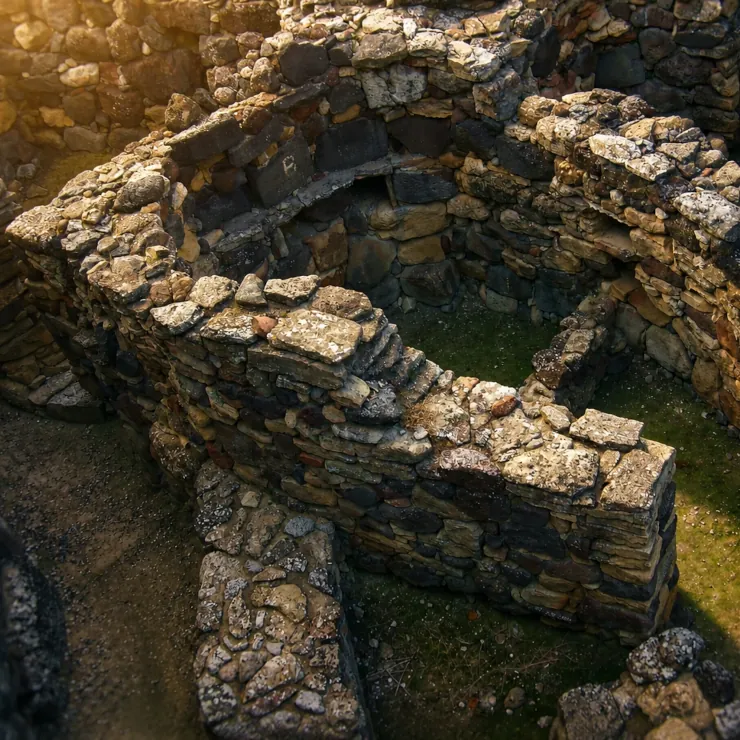
Scattered around the tower, the low, circular walls of an ancient village still trace the outlines of everyday life: sleeping quarters, storage rooms, workshops. Wander the narrow paths between them, and Barumini stops feeling like a museum and starts feeling like a place people actually lived in.
It is little wonder that UNESCO named Su Nuraxi a World Heritage Site in 1997, calling it one of the finest surviving examples of prehistoric defensive architecture anywhere in the world. That recognition has drawn travellers, historians, and curious wanderers from far beyond Italy, all eager to stand where the Nuragic people once stood.
But Barumini has more layers to peel back than the ruins alone. In the town centre, the elegant Zapata House, built by a noble Spanish family in the late 1500s, hides a secret beneath its floors: a second, smaller nuraghe named Nuraxi ‘e Cresia, only discovered at the end of the 20th century.
Suspended glass walkways now let visitors look straight down into this underground world without disturbing a single stone. At the same time, the museum around it holds a collection of artefacts pulled from the surrounding excavations.
Close by, a small museum honours Giovanni Lilliu, the archaeologist whose decades of work brought Su Nuraxi back into the light. Inside, a finely detailed model, one-tenth the size of the real complex, recreates how it might have looked in the 14th century BC, long before the tower lost its upper floor to time.
On a nearby hilltop stands the crumbling silhouette of 12th-century Marmilla Castle, its uneven six-sided walls built to fit the narrow crown of the hill. Little more than broken stone remains today, but even in ruin, the site still speaks of the fierce border conflicts it once stood guard over.