
 Islands Around
Sardinia and Sicily are the Mediterranean’s two largest islands, each with its own landscapes, climate, and natural beauty. Although both belong to Italy, they differ remarkably in terrain, coastline, vegetation, and volcanic activity.
Knowing these differences helps you choose the island that fits your interests, whether you prefer hiking, road trips, beach holidays, or outdoor adventures.
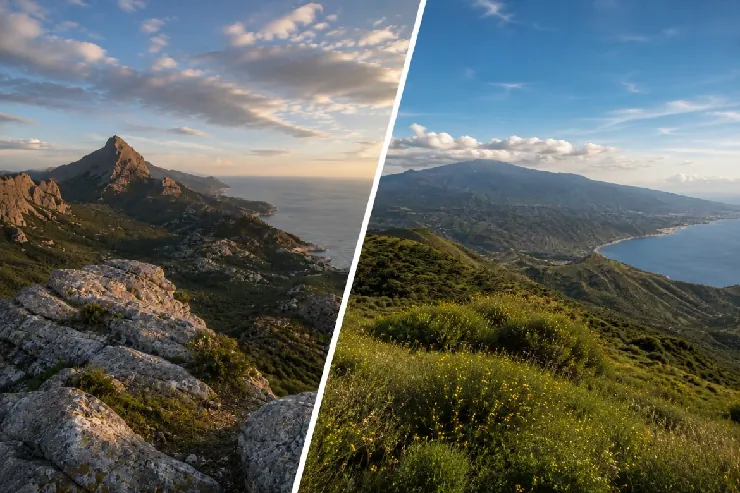
Sardinia’s interior features ancient granite mountains and rolling hills. Its highest peak, Punta La Marmora, rises in the Gennargentu range above forests, deep valleys, and quiet villages. Much of the interior is sparsely populated, which suits nature lovers looking for peaceful trails and panoramic viewpoints.
Sicily’s interior is more varied. Several mountain ranges cross the island, including the Madonie, Nebrodi, and Peloritani. Its best-known landmark is Mount Etna, Europe’s highest active volcano, where fertile volcanic soil supports vineyards and orchards beneath the rocky lava fields higher up.
Sardinia is famous for its coastline, with white sandy beaches, granite cliffs, hidden coves, and turquoise water. The northeast Costa Smeralda is internationally known, while La Pelosa, Cala Goloritzé, and Cala Luna show how varied the coast is. Sicily is the larger island, but Sardinia is usually described as having the longer coastline.
Sicily offers golden beaches as well as black volcanic sand shaped by Etna. Popular coastal areas include San Vito Lo Capo, Cefalù, Scala dei Turchi, and the beaches around Taormina, along with sea cliffs, marine reserves, and offshore islands.
Both islands have a Mediterranean climate with hot, dry summers and mild winters. Sardinia’s winds help moderate summer heat on its exposed western and northern coasts, and its mountains get more rain and occasional winter snow. Sicily is generally warmer, with hot summers in the south and inland, while Etna keeps snow on its slopes in winter.
The two islands have very different geological histories. Sardinia has large areas of ancient granite and metamorphic rock, shaped by erosion into rounded mountains and deep valleys, and it has no active volcanoes. Sicily is one of Europe’s most geologically active regions. Etna erupts frequently, and the Aeolian Islands show the same volcanic forces at work.
Neither island has large rivers, but both have valuable nature areas. In Sardinia, protected areas around the Gennargentu mountains and the Gulf of Orosei preserve forests, limestone cliffs, and rare Mediterranean species. In Sicily, the Alcantara River is known for its basalt gorges, formed by ancient lava flows.
Wildlife follows the landscape. Sardinia has wild mouflon, deer, and flamingos in coastal lagoons. Sicily has rich birdlife, marine ecosystems, and plants ranging from alpine species near Etna to subtropical ones on the warm coast. Protected marine areas are good for snorkeling and diving.
Travelers who want secluded beaches, rugged hiking, and quieter scenery often prefer Sardinia, and its coastal and mountain roads reward exploring by car. Sicily suits visitors who like contrast: in one day you can hike a volcano, visit wine-growing hills and hilltop towns, and swim from a sandy or volcanic beach.