
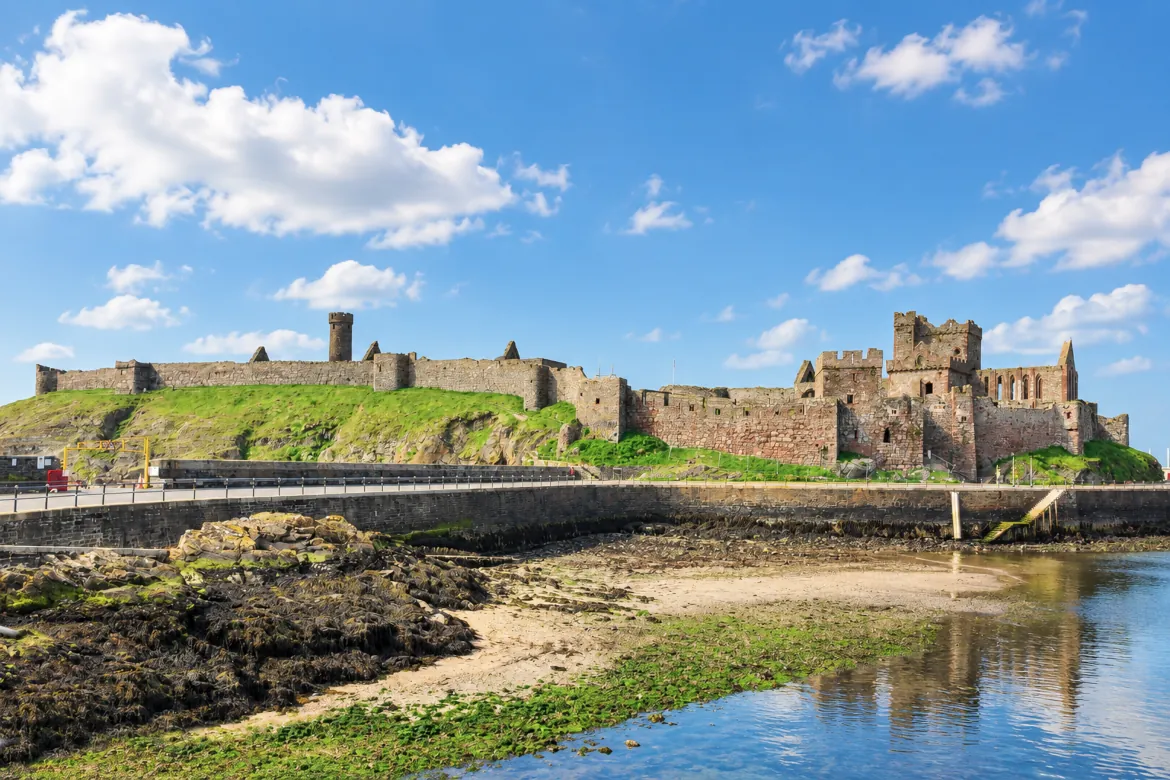
Before Peel Castle stood here, St Patrick’s Isle was a place of prayer, not war.
This page contains affiliate links, which may earn us a small commission.
For generations, monks lived on this small rocky islet off the west coast of the Isle of Man, tending a quiet religious community with nothing to defend and nobody to fight.
Then, in 1098, a Viking warlord called Magnus Barefoot arrived, looked at the islet’s position guarding the harbour below, and simply took it for himself. What had been a monastery became a military stronghold almost overnight.
Magnus and the rulers who followed him built walls, towers and gatehouses over the following centuries, layering fortifications directly on top of the monks’ old buildings rather than starting again elsewhere.
The result is the strange mixture visitors still see today: a round tower originally built for a bell, not a lookout, standing inside walls clearly built for war. Some of the monks’ world survived the takeover in other ways.
The site went on to become the seat of the Bishop of Sodor and Mann, and a cathedral was built within the same walls that had once housed Magnus’s soldiers, a reminder that religion never fully left the island even after the Vikings arrived. That cathedral was eventually abandoned to the weather in the 18th century, left as one more ruin among the rest.
Reaching the site today takes moments, thanks to a causeway built in the 1730s connecting the islet to the town of Peel. Before then, visitors needed a boat, or had to time their trip carefully to cross on foot at low tide.
Standing among the ruins now, with Peel’s harbour on one side and the open Irish Sea on the other, it is easy to see exactly what Magnus Barefoot wanted this small island for in the first place.