
According to legend, Katla was a bad-tempered housekeeper at Þykkvabæjarklaustur, a monastery in southern Iceland. People feared her temper. They also believed she could do magic. She had a pair of magic trousers. Anyone wearing them could run without getting tired.
One autumn, the monastery’s shepherd, Barði, could not find all the sheep before Katla came back. Worried, he borrowed the magic trousers and quickly found the whole flock. When Katla found out what he had done, she was so angry that she drowned him in a big container of whey and hid his body.
As the whey slowly disappeared, people heard Katla saying that Barði would soon appear. She realised that people would soon discover her crime. So she put on the magic trousers and ran towards the glacier. She disappeared into a deep crack in the ice. Soon after this, a huge flood came down from the glacier. People connected this flood with Katla’s magic, and later the volcano under the glacier was named after her.
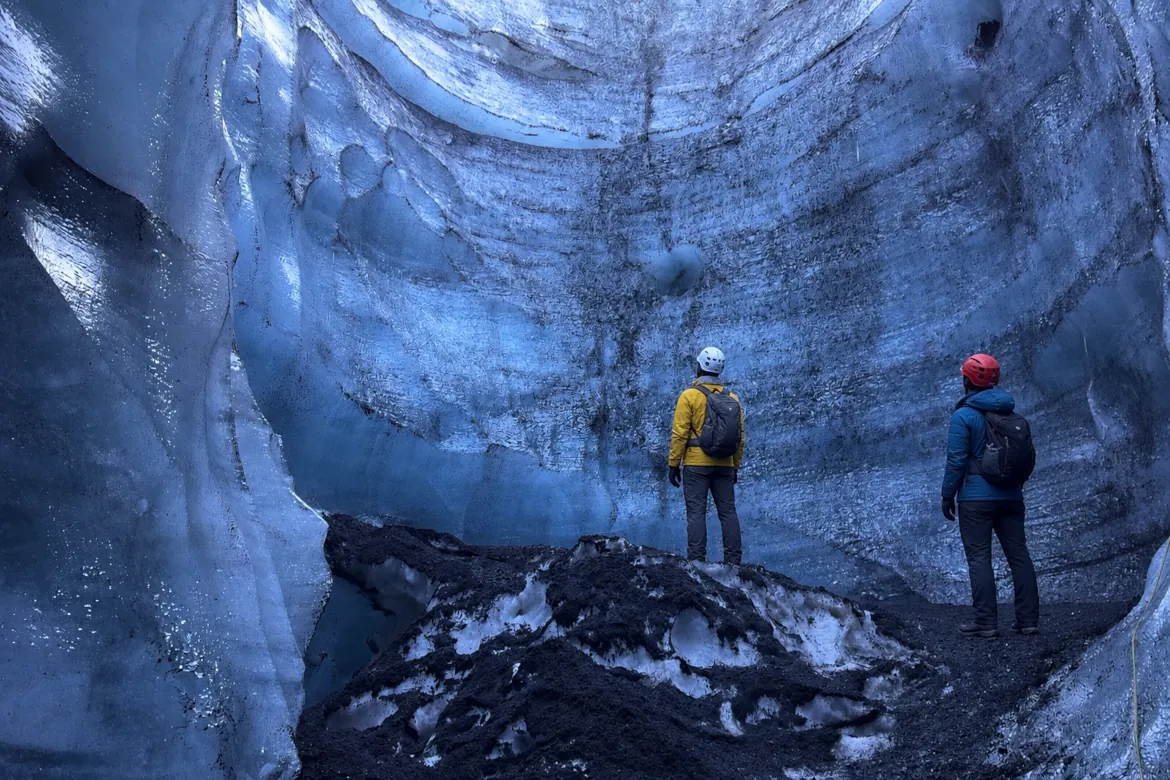
This story fits the landscape very well. Katla is one of Iceland‘s most powerful volcanoes, but most of it cannot be seen. The main part of the volcano lies under the Mýrdalsjökull glacier. The ice above it is up to 700 metres (2300 feet) thick, and it covers a huge caldera, a collapsed volcanic basin, that is about 9 by 14 kilometres (6 and 9 miles) wide and full of ice. No mountain top rises above the ice.
Instead, we only see the effects of Katla when fire meets ice. Its eruptions are usually explosive and produce ash. The heat from the rising magma melts the glacier ice. This can cause enormous floods, called jökulhlaups.
Katla has been very active throughout Iceland’s history. On average, it has erupted about every 50 years. At least 21 eruptions have occurred during the past 1,100 years. The last eruption that broke through the ice happened in October 1918. It lasted several weeks and produced a large ash cloud, as well as a major flood that spread across the plain called Mýrdalssandur. These floods are not just a side effect of the eruptions; they are one of the main dangers. The water from beneath the glacier has reshaped the land south and east of the volcano numerous times.
Katla’s volcanic system doesn’t stop at the edge of the caldera, though. It stretches for about 80 kilometres (50 miles) in total, including a line of cracks in the earth (called a fissure swarm) that runs northeast, under and beyond the ice.
Around the year 939 CE, one of these cracks caused a massive eruption called Eldgjá. It released about 20 cubic kilometres (5 cubic miles) of lava and ash. This was not a normal eruption from one mountain. It was a huge event across the whole volcanic system. It shows how far Katla’s power can reach beyond the area covered by ice.
More than 100 years have now passed since Katla last erupted through the glacier. This is an unusually long time between eruptions. But this does not mean the volcano is inactive. Icelandic scientists closely watch earthquakes, ground movement, and changes around the glacier.
However, if you stand on the road near the town of Vík, you cannot see any of this activity. You only see the wide, white glacier above the black plains, looking calm and quiet.
The old legend gives this silence a human meaning. Katla disappeared into the ice, and the volcano named after her has been hiding there ever since.
Some links on Islands Around are affiliate links, which may earn us a commission. All recommendations and reviews are independent and reflect our own opinions.