
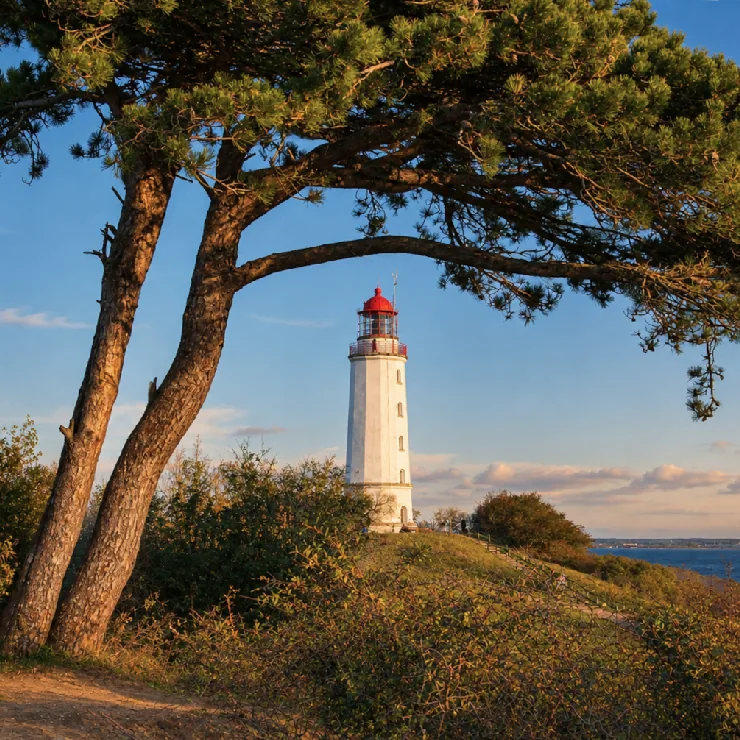
On Hiddensee, a long, thin island in the Baltic Sea, the land rises to a hill called the Bakenberg. At nearly 73 meters, it is the highest point on the island. The hill belongs to the Dornbusch, the hilly northern part of the island, and a lighthouse stands on the neighbouring hill, the Schluckswiekberg.
The lighthouse was built in 1888 and is 28 meters tall. Its light still guides ships across the Baltic. A narrow staircase leads to the top, where a balcony looks out over the water, the beach, and the green heath. From there, you can watch the sun set over the open sea. At night, the light sweeps across the water, and ships far out can see its flashes.
Hiddensee has no cars. Residents and visitors travel on foot, by bicycle, or in horse-drawn carriages, and only a few special vehicles are allowed on the island. The quiet makes it easy to hear the wind in the grass and the sea at the foot of the hill.
The Ice Age shaped the island’s northern hills. Glaciers pushed up a ridge of sand, clay, and stones, and over time the sea cut a steep cliff into its side. Today, the cliff continues to crumble slowly, so paths are kept well back from the edge. The beach below is covered with stones and driftwood.
Heath, shrubs, and sea buckthorn cover the slopes, and in autumn the orange berries of the sea buckthorn stand out against the sky. The island lies on a bird migration route, and in autumn thousands of cranes rest nearby on their way south. The weather changes quickly on the hill: fog can roll in and vanish, and the sky can clear within minutes.
In the village of Kloster, at the foot of the hills, narrow lanes lead past thatched houses and a small church. A house and a museum there remember the writer Gerhart Hauptmann, who won the Nobel Prize in Literature in 1912 and spent many summers on Hiddensee. Writers and painters have been visiting the island since the late 1800s, drawn by its light and quiet.