
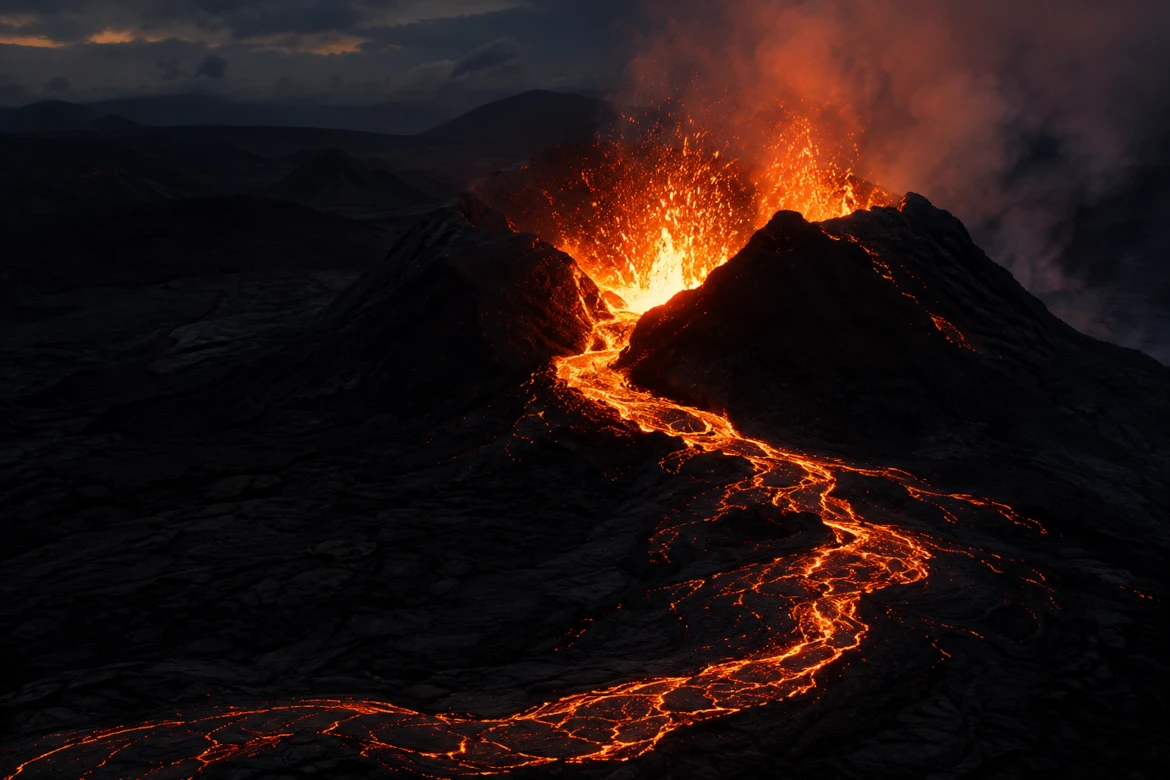
For six thousand years, nothing happened at Fagradalsfjall. A modest ridge of tuff and basalt rose above a scatter of quiet farmland on the Reykjanes Peninsula.
Icelanders who bothered to name it called it “the mountain of the beautiful valley.” It was the kind of name you give a place precisely because nothing dramatic is expected of it. This was sheep country and walking country, somewhere to note in passing on the way to the airport.
In February 2021, though, swarms of small earthquakes began shaking the ground beneath it, and geologists warned that magma was on the move. Then, on the evening of 19 March 2021, after weeks of tremors that had rattled windows as far away as Reykjavík, the ground split open and began to glow.
What followed was not the kind of event Iceland usually produces. There was no ash cloud grounding European flights, no glacial flood tearing out roads and no town under evacuation order. The valley is uninhabited, so the lava had nothing in its path to destroy.
Instead, thin red fountains rose from cracks in the earth. At its most spectacular, lava fountains shot up to 400 metres (1,300 feet) into the air, bursting in short bright spurts before falling still again. It was an unusually accessible eruption to observe safely. So people came to see it.
Reykjavík is only some 40 kilometres (25 miles) away, and within days a hiking trail had formed across the surrounding hills. It led tens of thousands of Icelanders and tourists to viewpoints overlooking the lava field, where they ate sandwiches and toasted marshmallows in sight of the flow. Over the six months the activity continued, more than 350,000 visitors are thought to have made the walk.
There was a peculiar tenderness to it. Locals began calling the new field of hardened rock Fagradalshraun, “the beautiful valley’s lava.” They were extending the old, gentle name to cover the very thing that had just buried the ground it described. Somehow it fitted.
The molten rock crept rather than roared. It spread through the neighbouring hollows of Geldingadalir and Meradalir in slow, glassy sheets, building small crater cones that onlookers could stand beside with little more than common sense for protection. Officials monitored gas levels closely and closed access to the site whenever pollution readings climbed too high.
Fagradalsfjall is, in a way, made from exactly what erupted from it in 2021. The mountain took its present shape long ago, built up from repeated bursts of lava beneath a glacier during the last ice age.
What made 2021 remarkable was not the mountain’s existence but its long silence finally breaking, and the fact that scientists could watch, in unusually clear detail, how magma moved through the crust and reached the surface. That gave them a rare look at how new rock is made.
It was not, as it turned out, a one-off performance either. The same system stirred again in August 2022, and once more in July 2023, when a new fissure opened at Litli-Hrútur a little further south. This marked a third consecutive summer of activity.
Eruptions on this peninsula tend to arrive in long-spaced clusters: centuries of stillness followed by active periods that can last decades. Fagradalsfjall’s awakening in 2021 looks, in hindsight, less like an isolated moment and more like an opening act.
Cross the black rock fields today and the old name still seems worth thinking about. There is nothing beautiful, in the ordinary sense, about a landscape of cooled basalt and steaming vents.
But there is something in the way this mountain broke its six-thousand-year silence so gently, and so publicly, that the old Icelandic instinct to call Fagradalsfjall beautiful doesn’t feel like an accident at all.
Some links on Islands Around are affiliate links, which may earn us a commission. All recommendations and reviews are independent and reflect our own opinions.