
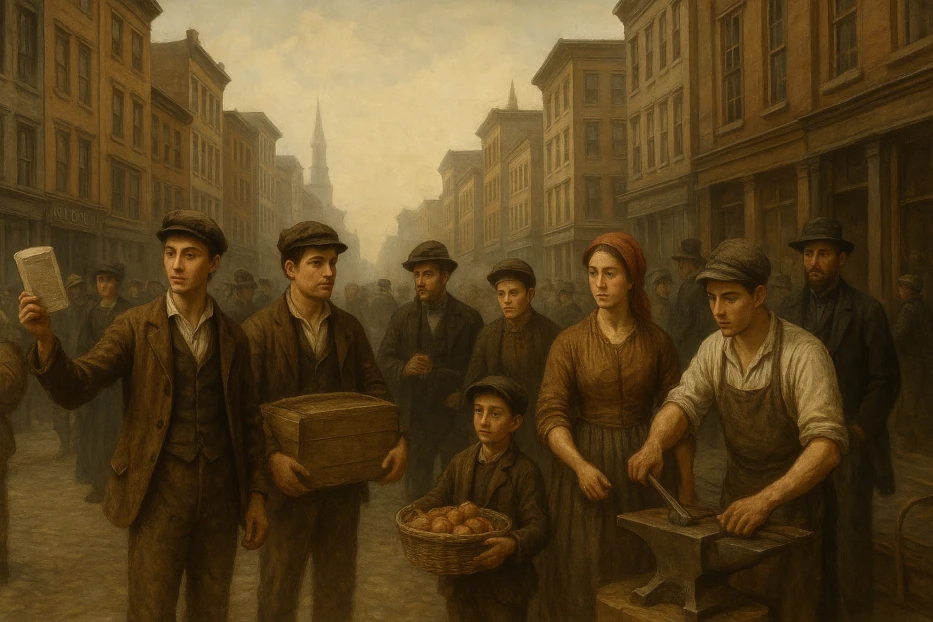
Working-class trades in 1850s New York formed a vibrant, noisy, and often harsh world where the city’s growth depended on the everyday labor of printers, dockworkers, street vendors, and countless others.
The working people of New York in the 1850s formed a world of constant motion, noise, grit, and determination.
The city was growing at a furious pace, and it leaned heavily on thousands of men, women, and children who performed the daily labor that kept the streets alive.
Anyone walking through Manhattan in those years would have moved through a shifting landscape of trades, each one shaping the identity of a neighborhood or even of an entire avenue.
A person’s morning might begin with the sound of printing presses echoing out of Newspaper Row. The narrow streets near City Hall vibrated with the rhythm of machines and the smell of hot metal.
Young men, often in their late teens or twenties, worked inside those shops from before dawn until long after sunset. Typesetting was a delicate skill that demanded sharp eyes and nimble fingers.
The tiny metal letters were arranged one by one into long lines of news, advertisements, and editorials, and the workers had to memorize countless fonts and sizes. Ink stained everything, even the breath of the place.
The presses themselves clattered so loudly that a newcomer might think he had walked into some metallic forest filled with mechanical birds shrieking from every corner.
Yet for many apprentices, learning the printing trade promised a steadier future than hauling cargo or sweeping chimneys.
Down at the waterfront, the city felt entirely different. The docks on both rivers were the true muscular arms of New York, hauling in the world’s goods at all hours.
Longshoremen and dock laborers came from every background imaginable: Irish immigrants, Black workers, Germans, and Yankees from upstate farms.
Their day began whenever the tide or the captain required it, and it often ended bruised, soaked, and exhausted. Barrels of molasses rolled across the planks with a sound like thunder, and bales of cotton were hoisted on ropes thick as a man’s wrist.
The work was dangerous. A slip on a wet board or a rope snapping under strain could cripple a man. Yet the riverfront had its own strange beauty.
The wind carried a mix of salt and tar, and gulls circled overhead while the shouts of foremen echoed against the ship hulls.
Many dockworkers believed they knew the city better than anyone else because they saw it from the place where New York breathed in the rest of the world.
If the docks were the lungs of the city, the streets around the Bowery, Five Points, and the lower wards were the city’s restless heartbeat.
Street vendors filled every corner, every curb, and every alley. They sold hot corn in little paper cups, apples polished to a shine, slices of pie wrapped in discarded newsprint, or knick-knacks imported from who-knows-where.
Some pushed heavy carts. Others carried wooden trays by straps around their necks. Still others simply balanced baskets on their hips and moved through crowds like fish in a stream.
Their cries formed a kind of music. One vendor might shout about oysters, another about gingerbread, and a child a few blocks away would be calling out the newest shipment of oranges from the Caribbean.
This small commerce supported entire families, especially widows or mothers whose husbands had left or died, and many immigrant children started their lives in America selling something that weighed little but demanded endless energy.
The streets also belonged to the newsboys, and they were impossible to ignore. They were usually boys between eight and fifteen, though a few tough young girls joined their ranks as well.
They scrambled across sidewalks, waving newspapers above their heads and chanting the headlines as if the city depended on their lungs alone.
The boys learned quickly that competition was fierce, and they developed a kind of streetwise cunning that shocked polite society.
They guarded their regular corners with the pride of soldiers and occasionally fought over the right to sell at ferry docks during the morning rush.
The success of a single day depended on whether the papers announced a shipwreck, a fire, or some scandal involving a politician. A slow news day meant fewer pennies and perhaps no supper.
Behind the doors of respectable houses, another group of working people kept the city running almost invisibly. Domestic servants rarely appeared in newspapers, but their presence shaped daily life in the homes of the middle and upper classes.
A household might have an Irish girl scrubbing floors, a German woman minding infants, or a young man serving as groom in the stable.
Their work followed the sun. Before anyone else stirred, they prepared fires, swept hearths, boiled kettles, polished silverware, and washed laundry by hand.
If wealthy families strolled through Broadway’s stores or attended the theater, it was often because servants remained at home ironing dresses, minding children, or simmering stews.
For many newly arrived immigrants, domestic service meant security, even if it came with long hours and little freedom.
Carpenters and joiners added to the hum of working life, especially as the city grew northward. Streets that had been farms only a decade earlier were now lined with row houses under construction.
Wooden frames rose like skeletons in the morning fog, and sawdust drifted in the air like pollen in spring. Blacksmiths kept horses shod for both work wagons and the omnibuses that rumbled through Manhattan.
Their forges glowed red even in the heat of summer. Shoemakers, tailors, seamstresses, and milliners filled tiny workshops where needles flew as quickly as hands could drive them.
The clothing trade was one of the few that employed large numbers of women, many of whom stitched garments at lightning speed for only a few cents a piece.
If one wanted another kind of soundscape, the volunteer fire companies provided it.
Although technically unpaid, many firefighters were working-class men whose trades lent them the strength and agility needed for such dangerous and chaotic work. Their rivalries were legendary.
A fire engine racing through the streets brought not just attempts to save property but an explosion of noise, drama, and sometimes fistfights over which company had the right to operate the pump.
The thrill of it appealed to young men from print shops, docks, stables, and workshops, and the firehouse often served as a social club where tradesmen forged bonds that cut across ethnic divides.
Walking from one neighborhood to another in 1850s New York meant crossing invisible borders defined by these trades.
The Bowery might smell of hot corn and cheap beer, while the waterfront reeked of salt and fish, and Park Row felt heavy with paper dust and ink.
The city was not yet the financial and corporate center it would later become. Instead, it was a patchwork of labor, each thread colored by the hands that pulled it tight.
The working class built Manhattan one barrel, one brick, one printed sheet at a time, shaping the future even if few ever saw themselves as historical figures.
And through all this activity ran a shared truth. No matter the trade, no matter the hour or the neighborhood, the people who worked with their hands in the 1850s gave New York its pulse.
They carried the city into the modern age, long before skyscrapers touched the clouds or electric lights turned night into day. Their world was noisy, dirty, exhausting, and alive — and it left traces that still echo in the city’s streets today.