
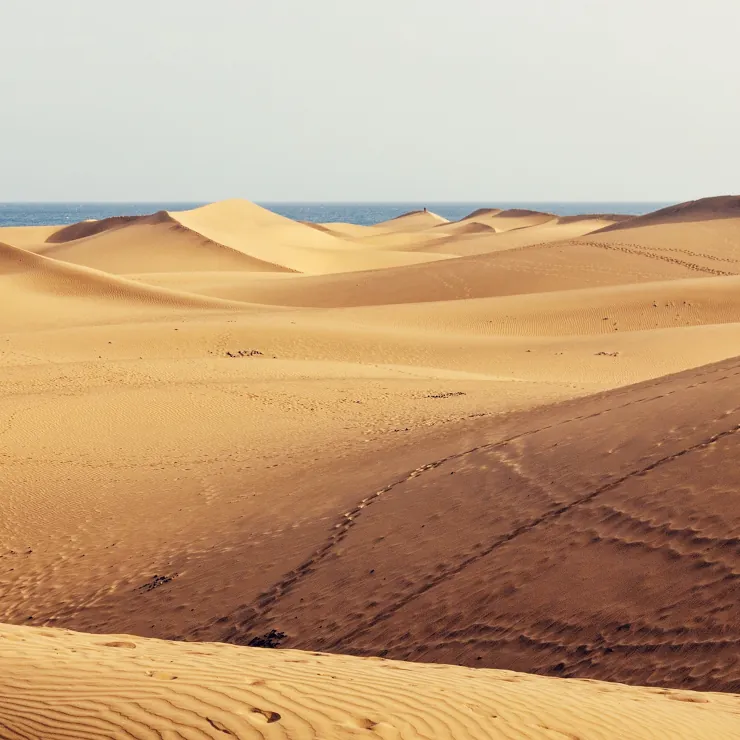
Few landscapes look as strange as the Maspalomas Dunes. Surrounded by hotels and busy resort streets on one side and the open Atlantic Ocean on the other, this area of golden sand on Gran Canaria is, geographically speaking, part of Africa.
The dunes lie between Maspalomas and Playa del Inglés, forming one of the most unusual landscapes in the Canaries. Much of the sand comes from the beach, where marine currents deposit sediment on the shore. Once dried by the sun, the sand is picked up by the strong trade winds and carried inland, slowly building up the dunes. The dunes are never completely still. The wind keeps changing their shape over time.
What makes this place special is not only its beauty, but also the wildlife living there. Behind the dunes is the Charca de Maspalomas, a small lagoon with brackish water, meaning it is neither fully fresh nor fully salty, but somewhere in between. This lagoon is an important resting place for birds flying between Europe and Africa.
The wider area around Maspalomas is also home to the Gran Canaria giant lizard, a species found nowhere else in the world, as well as plants such as the tree gorse, adapted to shifting sand and salty coastal winds.
The area first received legal protection in 1987 as a Paraje Natural de Interés Nacional (National Natural Site). In 1994, it became a Reserva Natural Especial (Special Nature Reserve), which it still holds today.
The rules for managing the reserve limit visitor access and require people to stay on marked paths, in order to protect the fragile habitats and species living there.
At one end of the dunes stands the Maspalomas Lighthouse, built in the second half of the 19th century to help guide ships sailing along this part of the southern coast of Gran Canaria. A symbol of Gran Canaria, the lighthouse became a Cultural Asset in 2005 and is one of the Canary Islands’ oldest working lighthouses.