
 Arno Hoffmann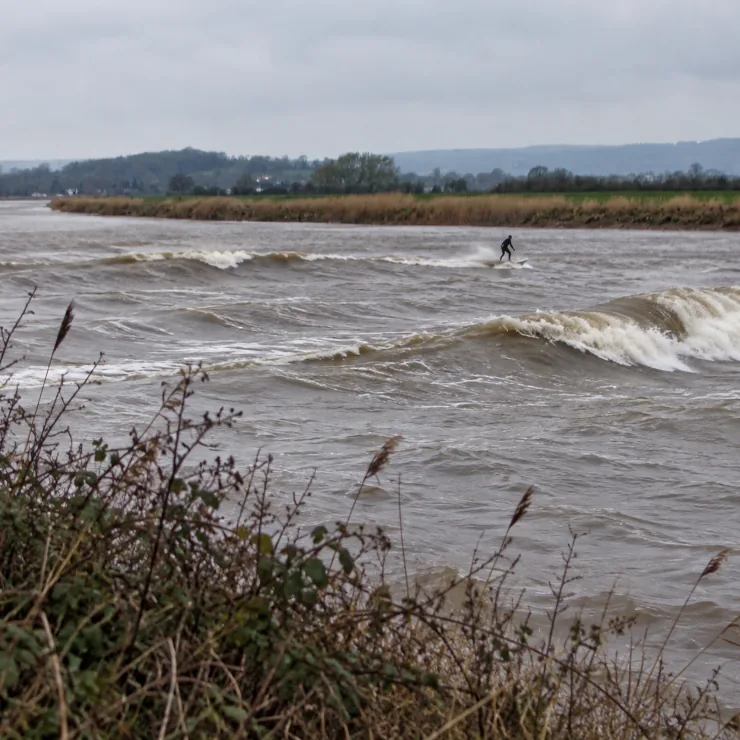
On about 130 days a year, something strange happens on a stretch of water in southwest England. Instead of simply flowing out to sea, the River Severn briefly meets a wall of incoming water.
The wave surges upstream as crowds gather on the banks to watch.
The Severn is the longest river in Great Britain, running for roughly 220 miles from its source in the Welsh mountains to the Bristol Channel. Along the way, it flows through Shropshire, Worcestershire and Gloucestershire, with the towns of Shrewsbury, Worcester and Gloucester standing on its banks.
It is the river’s final stretch, where it widens into the Severn Estuary, that produces its most famous feature: the Severn Bore.
The bore exists because the Severn Estuary has one of the largest tidal ranges in the world, with the difference between low and high water reaching about 43 feet.
As the incoming tide is squeezed into the estuary’s narrowing, shallowing funnel, the water is forced upward and forward, forming a wave that travels against the river’s natural flow.
Each of those days brings two bores, one in the morning and one in the evening, mostly just after the new and full moon. Smaller ones appear throughout the year, but the biggest arrive around the March and September equinoxes.
The wave can reach about seven feet in height and travel at 8 to 13 mph, pushing upstream as far as Gloucester and sometimes beyond before fading.
Experienced surfers have ridden the bore for 7.6 miles in a single run, a Guinness World Record set in 2006. Forecasts have traditionally used a five-star scale to indicate how dramatic each bore is expected to be.
The Severn is not the only British river with this trick. Further north, the River Trent produces a smaller tidal wave of its own, locally known as the Trent Aegir.
But the Severn remains Britain’s best-known tidal bore, drawing crowds when the largest bores arrive around the equinoxes.