
 Islands Around
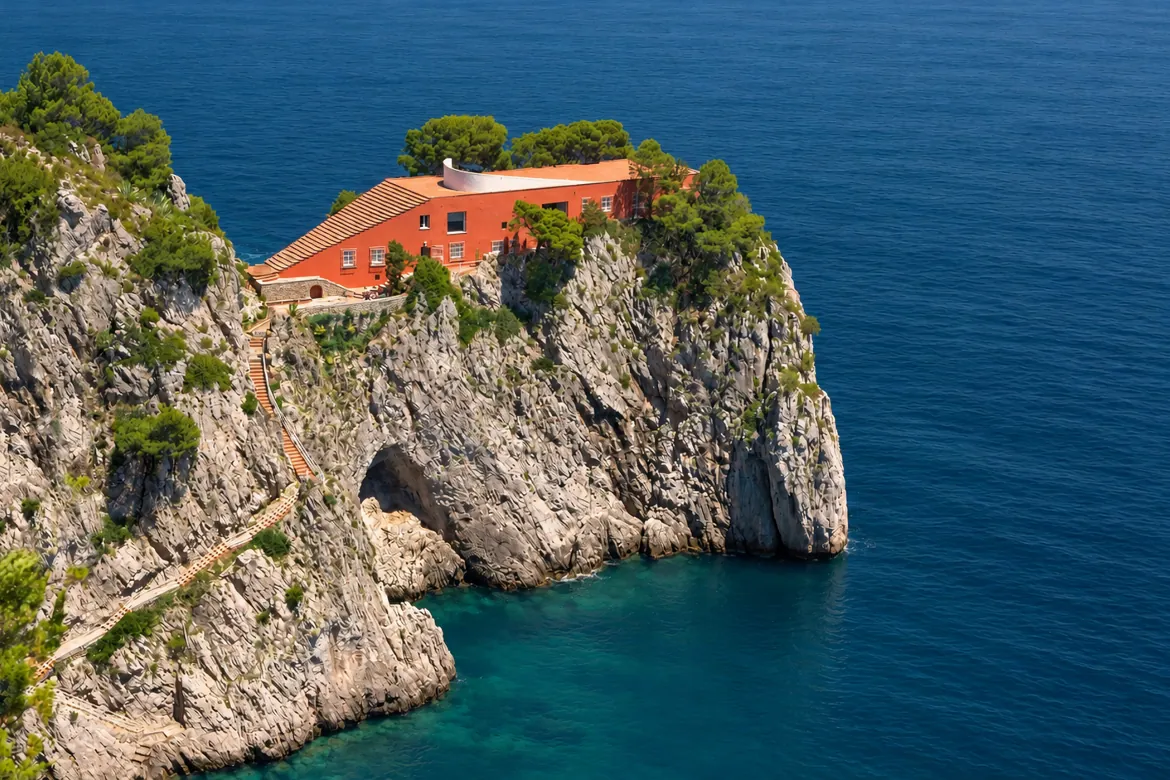
A steep red house sits on a cliff on the eastern side of Capri, cut off from roads and reachable only on foot or by boat. It looks like nothing else on the island, and the story of how it was built is just as unusual.
This page contains affiliate links, which may earn us a small commission.
The house belonged to Curzio Malaparte, an Italian writer and journalist known for his sharp, difficult character. In the late 1930s, he hired Adalberto Libera, one of Italy’s leading architects at the time, to design a home on a remote point called Punta Massullo.
Malaparte soon fell out with him. He rejected Libera’s plans, calling them too plain, and pushed the architect aside. With the help of a local stonemason, Adolfo Amitrano, Malaparte went on to build the house largely by himself, finishing it in the early 1940s.
The result was a long, narrow red building with an unusual staircase on the roof, shaped like an upside-down pyramid. Malaparte called it a self-portrait built in stone, saying he wanted a house that matched his own personality rather than any architectural style.
After Malaparte’s death in 1957, the house stood empty for decades and fell into disrepair. It only became widely known outside Italy in 1963, when the French director Jean-Luc Godard filmed key scenes of Le Mépris there, with Brigitte Bardot sunbathing on its flat roof. The film brought international fame to a building that had been almost forgotten, and gave the wider public its first proper look inside.
In the late 1980s, Malaparte’s family began a long restoration project. The house remains private property today, closed to casual visitors, unlike the crowds who reach Villa Jovis or the Faraglioni rocks nearby.