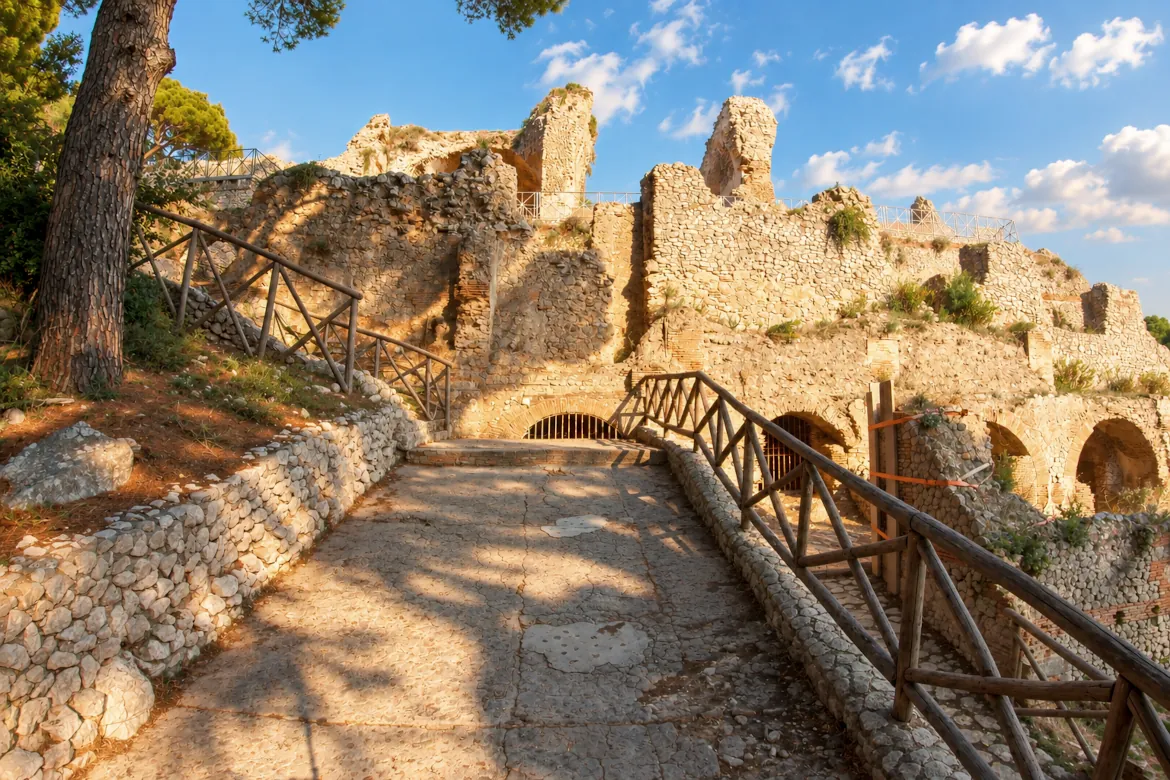
Around AD 27, the Roman Emperor Tiberius left Rome and moved to Capri. He stayed on the island for roughly the last ten years of his life.
This page contains affiliate links, which may earn us a small commission.
During that time, he governed one of the largest empires in the world from a small island in the Bay of Naples. He ruled the empire from AD 14 until he died in AD 37.
The island was already popular with Roman rulers. Augustus, the first emperor, took Capri from the city of Naples in exchange for the island of Ischia, and he often stayed there. Tiberius, who followed him as emperor, went further and made it his home.
Historians think he wanted to escape the political intrigue in Rome. He also seems to have feared that someone would try to kill him. A remote villa on a steep cliff was easier to protect than a palace in the middle of the city.
His best-known home was Villa Jovis, the Villa of Jupiter. It was the largest of twelve villas that the Roman historian Tacitus said Tiberius had on Capri. Its ruins stand on a high, remote cliff on the east side of the island, far from the shops and cafés of the modern town. Even today, the villa can only be reached on foot, by a steep path.
Life on the island had practical limits, even for an emperor. Capri has no natural springs, so the Romans collected rainwater in tanks called cisterns. The remains of many ancient cisterns survive.
Later Roman writers described scandalous behaviour at the villa. One of them, Suetonius, wrote long after Tiberius died, and many of his stories cannot be checked. The ruins themselves show a palace on a very large scale.
Villa Jovis was not the only site linked to him. Ruins of other villas lie around the island, including one near the Blue Grotto, and tradition places another where Villa San Michele stands in Anacapri.