
 Islands Around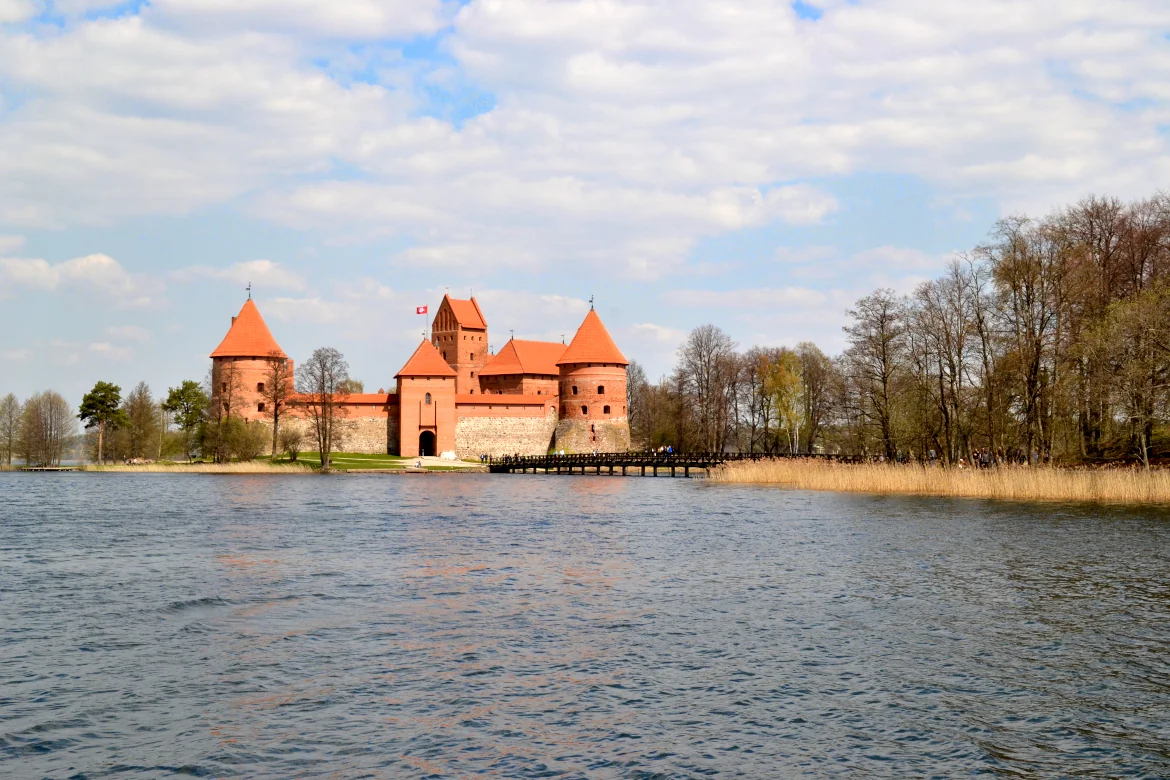
From the far shore of Lake Galvė, Trakai Island Castle looks like a fairy tale in red brick. A medieval military engineer, however, would have read the same view very differently, because one of the most interesting features of the fortress is easy to miss. It sits in the corners.
This page contains affiliate links, which may earn us a small commission.
In the run-up to the Battle of Grunwald in 1410, the castle was enlarged and became a highly innovative fortress. Its walls were strengthened and given additional firing galleries, and the corner towers of its forecourt were adapted for flanking defence and held fifteen cannons.
The principle is simple. Defenders standing behind a straight wall can only shoot at what is directly in front of them, so an attacker who reaches its foot may be almost impossible to hit. Towers at the corners change the situation, because the men inside can fire along the wall itself. Anyone trying to climb or undermine it is suddenly exposed to attack from the side.
The scale of these towers helps to explain their role. The three corner towers rise to about eighteen metres. Each stands on a square stone base about thirteen metres wide, with walls roughly five metres thick, and from the second floor upwards it becomes circular and is covered by a conical tiled roof. The top storey was reserved for soldiers and cannons.
Modern visitors to Trakai rarely think about any of this, and the towers they admire are in large part the result of rebuilding. In the nineteenth century, a Lithuanian engineer, B. Malevskis, prepared a project to restore part of the south-eastern tower, but the work carried out was limited. That tower was rebuilt in the years before and at the start of the Second World War, and the other corner towers of the forecourt were rebuilt as part of the restoration completed in 1987.
Today the fortress displays knights’ armour and old weapons in its museum halls, a fitting reminder of what the corner towers were designed to do. The original idea, that a castle can strike back from its edges, still explains why its outline looks so purposeful.