
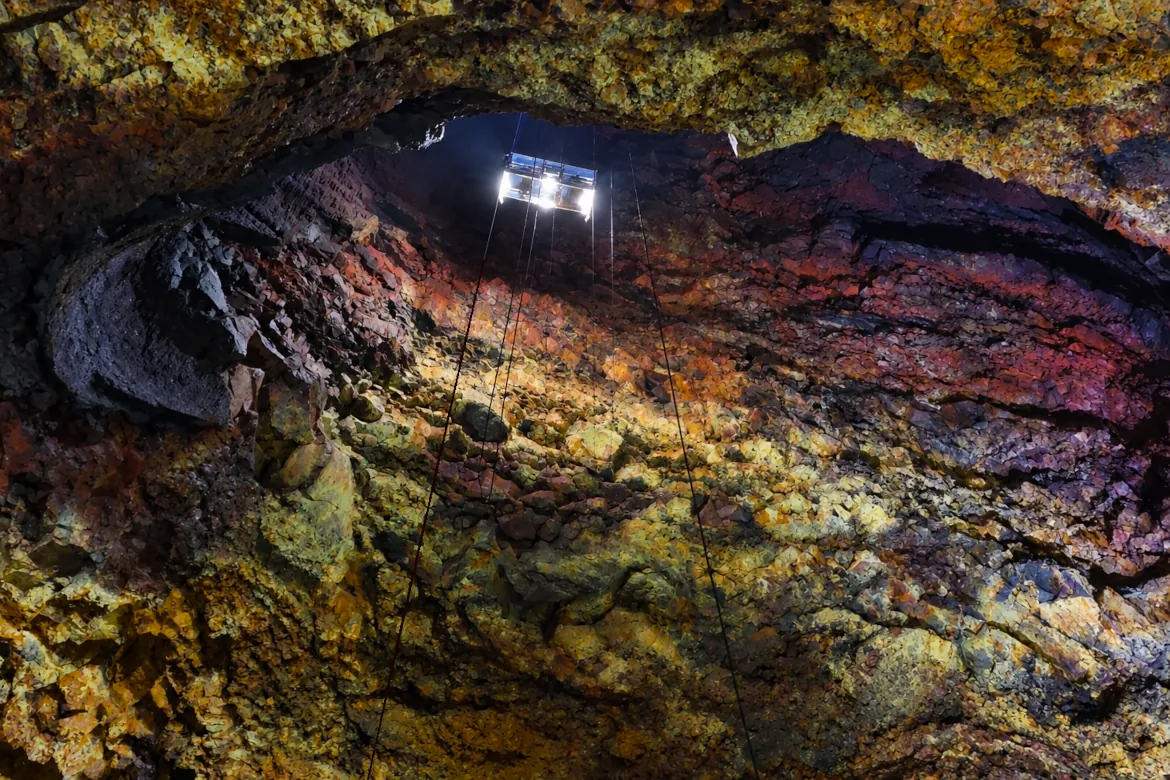
Somewhere beneath the mossy lava fields southeast of Reykjavík lies Þríhnúkagígur (Thrihnukagigur; meaning “Three Peaks Crater”), a volcano whose last eruption should have sealed it shut with cooling lava, or left it to collapse in on itself.
Instead, some 4,000 years ago, the molten rock inside simply vanished, leaving a hollow chamber that has never been filled or closed.
The person who found it was not a scientist but a doctor with a passion for caving. In 1974, Árni B. Stefánsson lowered himself into a narrow opening in the ground, unsure what he would find below.
What met him was a chamber dropping more than 210 metres (nearly 700 feet) into the earth, its walls marked with shades of red, yellow and black left by minerals in the rock. It was more than twice as deep as the Statue of Liberty is tall, including its pedestal, on Liberty Island in New York.
Stefánsson had reached the channel that once carried liquid rock, under enormous pressure, on its way to the surface. Instead of danger, he found only quiet and colour.
Volcanologists who later studied the site found nothing quite like it elsewhere. Haraldur Sigurdsson, who examined the chamber, suggested the magma had drained back dowOutside of these rare occasionsnward through cracks deep in the crust rather than cooling in place, though exactly why the space above survived intact, unsupported and hollow, is a question researchers are still working through.
For decades after Stefánsson’s discovery, Þríhnúkagígur stayed largely unknown outside a small circle of Icelandic cavers, who kept returning to explore the chamber further.
It sits within the Bláfjöll mountains, part of the wider Brennisteinsfjöll volcanic system, a short distance from Reykjavík, hidden beneath a landscape of moss and broken lava that gives little hint of what lies beneath.
It was not until 2012 that the magma chamber opened to visitors, using a lift originally built a couple of years earlier for scientific work. Since then, people have been lowered through the same narrow opening Stefánsson once entered alone, this time inside a metal cage rather than on a rope.
It remains the only volcano in the world where visitors can descend by lift into a magma chamber. What they find at the bottom covers an area of about 3,270 square metres (35,200 square feet), enough space for several tennis courts placed side by side.
The walls are covered in patches of colour: yellow where sulphur-rich gases have left their mark, and deep red where iron in the rock has reacted with the air over thousands of years. Researchers are not entirely sure whether tiny living organisms have also played a part in producing these colours, alongside the minerals themselves.
The silence Stefánsson once found there has not always lasted. In August 2015, members of the Icelandic band Kaleo, together with fourteen support staff, were lowered into the chamber to record a live rendition of their song “Way Down We Go”, turning the stone walls that once carried liquid rock into a stage for something entirely different.
Outside such rare occasions, the chamber returns to what it has been for four thousand years: still, dim, and largely undisturbed. Geologists monitoring Iceland’s volcanoes regard Þríhnúkagígur as dormant, with no sign of renewed activity since its last eruption.
For visitors today, the descent ends where Stefánsson’s curiosity once did: standing inside a mountain that, by every geological rule, should not still be hollow.
Some links on Islands Around are affiliate links, which may earn us a commission. All recommendations and reviews are independent and reflect our own opinions.