
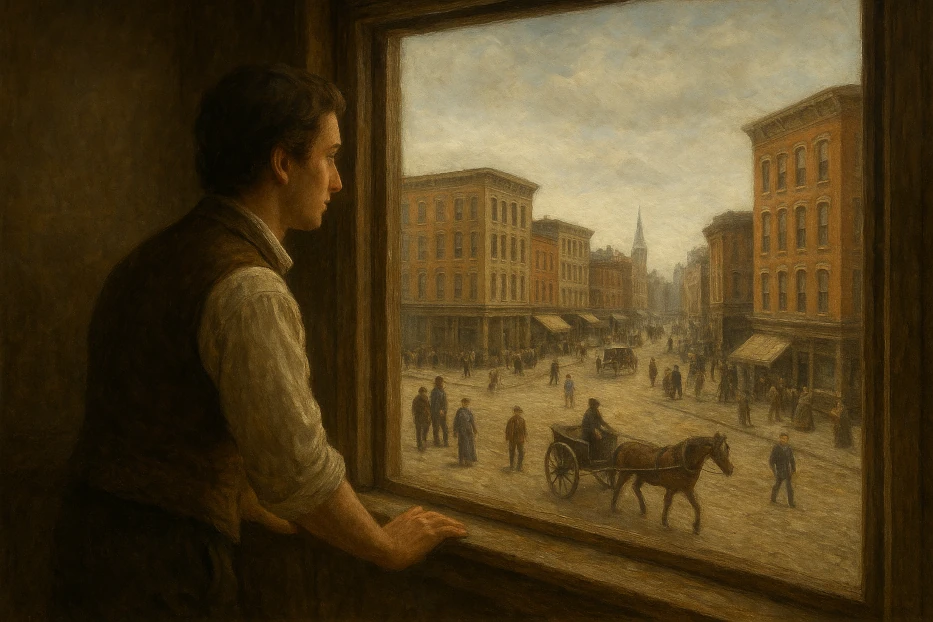
What did a normal summer day feel like in Manhattan in 1855? What did people eat, see, smell, fear, or love?
This fictional diary — built from real details of mid-19th-century New York — follows one young man through a single day:
June 5th, 1855.
From omnibuses on Broadway to beer halls on the Bowery, from Castle Garden to crowded tenements, this is a glimpse into the heartbeat of a city transforming into the New York we know today.
The Diary of Thomas Callahan – 5 June 1855
New York, Tuesday, June 5th, 1855
I woke this morning to the sound of the milkman’s bell clanging down Broome Street, and for a moment I thought I had slept too late and the sun was halfway to the sky already.
But when I pushed the shutters open, the city was still wiping the sleep from its eyes — the sky a pale cotton color above the rooftops, the air smelling damp from the night storm that had left puddles in all the cobbles.
June mornings always feel a little sticky, and today was no exception. Still, there was something lighthearted in it, something promising. Maybe because I had no foreman yelling at me yet.
Mother had left rolls and cold pork on the table. She’d already gone to the market on Catherine Street, where she says the fishmongers treat her better if she arrives before their tempers sour with the heat.
My older brother Patrick was long out the door — he works at the docks and often eats breakfast from a street stall, usually salted cucumbers or a meat pie still wrapped in yesterday’s news.
Our rooms are small (three rooms for four people), yet we’re luckier than many who live nearby.
On our block alone, there are two boarding houses filled with German families and single clerks, and a narrow, sagging tenement behind ours where it always smells of steam and cabbage.
But I like our neighborhood. A little rough, but lively; and in the mornings, the bakery three doors down fills the street with the smell of fresh bread that reminds me of the stories Father used to tell about home in Ireland.
I headed to work at half past six. The sun had climbed enough to warm the street but not enough to make the day unbearable. I walked north toward Houston Street, dodging puddles and the sweepers clearing away last night’s trash.
Everywhere I heard the usual chorus — street vendors calling in English, German, and Irish; the clip-clop of horse hooves; the soft grind of cart wheels; and far off, the whistle of a ferry on the East River.
New York seems to grow louder every week, as if the city is clearing its throat before shouting itself into the future. Some say it will be the greatest city in the world someday.
Maybe it already is, though the people who live here certainly don’t act like royalty. More like ants scrambling along the docks, sweating and cursing.
Work was work. I spend most days in a printing shop near the Bowery. It’s a hot place, even in winter — the type presses groan, and the whole floor vibrates with the rhythm of the machinery.
But the work keeps me busy, and the owner, Mr. Harrow, isn’t the worst of them. He’s a crank, certainly, but he knows the trade, and if you don’t mess up his type cases, he leaves you be.
Today we were printing pamphlets for a temperance society, which amused us, since half the men in the shop drink ale at lunch just to get through the shift.
Around noon, I escaped into the Bowery air, which was only marginally less hot than the shop but smelled more of horse manure than ink. Lunch is never a quiet affair in the Bowery.
There are ticket hawkers shouting about minstrel shows, barkers trying to lure men into saloons, newsboys darting through crowds with the latest edition of the New York Herald or the New-York Tribune, and barbershops with striped poles out front, promising shaves for a dime.
And then there are the omnibuses — those lumbering beasts of public travel — always overstuffed, always rumbling, and always, inexplicably, holding up traffic for minutes at a time.
I bought a sandwich of corned beef and sat on a stoop to eat it. A group of German men sat near me drinking lager, laughing loud enough that a policeman told them to tone it down.
The Bowery has changed much since I was a little boy — they say a man can now traverse the entire length without getting robbed if he walks quick and pretends to know where he’s going.
But the stories of gangs are still true enough. Everyone knows the Dead Rabbits fight the Bowery Boys, sometimes so fiercely that whole blocks are shut down. Lately, though, things have been quieter. Maybe the heat has slowed their blood.
After lunch, I had an errand uptown, so I hopped onto an omnibus traveling up Broadway.
The fare was six cents, which I begrudged paying because it saved me only about half an hour of walking. But the sun was growing fierce, and my shirt was already stuck to my back.
Besides, I had never minded the chaos of Broadway; it’s the artery of the city and feels alive in a way I can’t fully explain. The stores there glitter with goods that only the wealthy can afford: French ribbons, fine silks, watches, gloves, parasols.
Ladies in wide panniered skirts and light summer gowns strolled beneath parasols, looking delicate yet determined, as if they’d call for a policeman if anyone stepped on their hems.
Sometimes I stare perhaps too long at those silks and imagine what it would be like to have money enough to buy such things. But then I remind myself I would be a different person with that kind of wealth, and perhaps a duller one.
The omnibus clattered uptown toward Union Square, where elegant houses encircle the green and carriages make the streets look like a parade ground.
From there, I walked another ten blocks to Mr. Stanhope’s residence. He is a publisher, and our shop had botched a batch of his calling cards by mixing letters in his middle initial.
I was the unlucky soul sent to apologize and deliver new ones. His home was grand, with a stoop so polished it gleamed.
A maid let me in and delivered the cards while I stood in the foyer, trying to appear as though houses like this were a daily sight to me. When she returned, she said the cards were fine, and that was that.
I walked back downtown, taking a detour through a small park near the university. Children were running around the fountain, and a group of college fellows from NYU were sitting on a bench reading newspapers.
The elms around the park cast a lovely shade, and I sat there for a few minutes just to rest. A man was selling ices from a pushcart: colored, flavored ice, sweet and cooling. I bought one for two cents, and it was worth every penny.
As I sat licking the melting ice, I watched a nursemaid trying to corral two toddlers who seemed bent on throwing themselves into the fountain. A couple strolled by arm in arm.
A group of laborers lay asleep in the grass, their hats over their faces. All around them, the city hummed, but softer here: gentler, as if the trees muffled the noise.
By the time I returned to the printing shop, the afternoon heat had turned the interior into a furnace.
Every man was sweating freely, and ink mixed with perspiration is a truly vile scent. We worked until six, when the shutters were pulled down, and the presses stopped rattling.
I walked home with a fellow named Reilly, who talked the whole way about wanting to join the volunteer fire brigade, specifically Company No. 6. He said they have the best engine and that the girls like a man in a fireman’s jacket.
It’s true — at festivals and parades, the fire companies march like soldiers, polished helmets gleaming. New York has no paid firefighters yet; it’s all volunteers, and they act like half-warriors, half-boys playing at war.
At home, Mother had cooked beef stew with carrots, and she insisted we sit down together even though Patrick was late coming back from the docks.
When he did arrive, he brought stories — there had been trouble unloading a ship full of molasses, and some barrels burst, covering two men and half the pier in sticky brown goo. He smelled faintly of sugar and river water.
After dinner, the air felt cooler, so I went for a walk down toward the Battery. The journey took me past City Hall Park, where newsboys were still hurling headlines into the gathering dusk.
The new telegraph lines behind the newspaper offices crackle every day with news from Washington and even from overseas when ships arrive.
People say information moves faster than horses now, and maybe that’s true. The whole city seems to beat quicker because of it.
By the time I reached the Battery, lamps were being lit along the street — gas lamps, glowing with soft yellow halos. Families strolled by the waterfront, enjoying the breeze that swept off the harbor.
Ferries came and went, their lanterns bobbing on the water. Castle Garden stood proudly at the tip of Manhattan, a former concert hall now repurposed as the city’s new immigrant depot.
Tonight, music spilled out faintly, violin strains carried on the wind. I lingered on a bench watching the silhouettes of ships anchored offshore and the Staten Island ferry gliding like a ghost.
Nearby, a group of Irish immigrants freshly arrived stood clutching their bundles, unsure which way to go.
I remember when we first arrived in ’48 — I was small, but I still recall the hunger on the ship, the coughing, the fear, and yet the thrill of seeing New York rise like a dream out of the fog. That feeling returns to me occasionally, when the light hits the city just right.
Walking home through the Lower East Side, I passed German beer halls alive with singing and violin music. I heard a chorus of men and women singing “Du, du liegst mir im Herzen,” and though I didn’t know the words, the music warmed me.
Farther west, I crossed into rougher alleys where drunkards lay sleeping against brick walls and children, barefoot, darted between adults selling fruit or oysters. In summer, the oyster sellers stay out late — the bivalves are cheap and plentiful, practically the city’s fast food.
The night smelled of baked bread, horse sweat, tobacco, and sometimes the dreadful stink of the gutters. But somehow it is all familiar, almost comforting. This is my city now, and its chaos is the rhythm of my own life.
At home, the lamps were low. Mother and Patrick were asleep; only Father was awake, smoking his pipe by the window. He looked tired. Tiredness surrounds him lately like a shadow.
We talked a little about work, about the rising prices of everything — from rent to flour — and about the riots last month.
Another flare-up between nativists and immigrants. It troubles him that the old country’s troubles follow us here. For all its promise, America has its own cruelties.
But then he smiled and asked whether I’d saved anything from last week’s wages, or if I’d spent it all at the Bowery theaters. I told him I had saved some — enough, at least, to buy a new pair of cuffs for church. He laughed and ruffled my hair like I was still ten.
I came up to my room now to write these lines by candlelight. The window is open, letting in a warm breeze.
Outside, I hear a last omnibus rumbling down Broadway, someone calling for a lost dog, and, faintly, the distant clang of a volunteer fire bell — Company No. 6 perhaps, racing through the streets like heroes.
I am tired, but not unhappy. The world feels enormous tonight.
This city is changing every month, growing like a living creature — stretching upward, outward, faster than anyone can quite understand. And I, a single young man on Broome Street, am carried along with it.
Tomorrow I will rise again with the milkman’s bell and the rumbling carts. But tonight, on this warm June evening in the year 1855, I am simply content to be part of New York, magnificent and maddening as it is.
—T.C.