
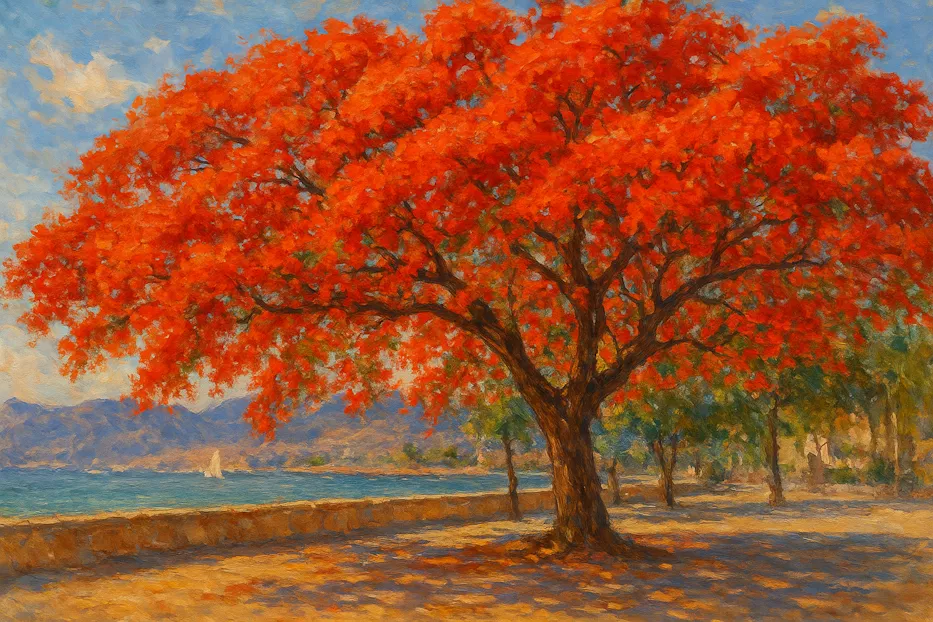
Far from the island’s volcanic drama and postcard views, the Royal Poinciana in Tenerife offers a gentler invitation into summer: an understated ritual of shade, light, and lingering that reveals the island at its most contemplative.
In early summer, when the Atlantic light sharpens and the island’s pace seems to lengthen by a half step, Tenerife undergoes a seasonal transformation that is not announced by festival, nor by any official marker of the calendar. It arrives instead in a hush of color — an emergence of flame-bright canopies that appear almost overnight along streets, in public gardens, and in the patios of old Canarian houses. The Royal Poinciana, long naturalized here, begins to flower, and the island seems to exhale into the season.
The first sighting often happens in motion: from a taxi window leaving the airport, or while rounding a bend on the TF-5 as the road tilts toward the sea. A tree — its branches held wide in a gesture that suggests both shelter and spectacle — burns with a red so saturated it arrests the eye before the mind has time to name it. Against the deep marine blue and volcanic earth, the color feels almost architectural, as if an artist had placed it deliberately to counterbalance the island’s darker palette. It is a moment that stays with visitors, not because it is grand, but because it is quietly assertive – a signal that summer here is meant to be looked at, not simply passed through.
The Royal Poinciana is not native to Tenerife; its origins lie in Madagascar. Yet its presence on the island feels less like an introduction and more like a natural fit. The tree arrived in the nineteenth century, carried by botanical curiosity across colonial trade routes, part of a period when European gardens filled with exotic species. On Tenerife Island, it found a climate that suited it — heat softened by trade winds, volcanic soil with just enough mineral generosity — and rooted itself with ease. Over time, it slipped from ornamental import to seasonal companion.
To encounter the tree at the height of its bloom is to understand why it endured. Its flowers gather in dense clusters, a chorus rather than a solo, and the foliage — delicate, fern-like — gives the branches an airy structure, as though the tree is composed as much of light and space as of leaf and wood. Stand beneath the canopy and the effect is not overwhelming but surprisingly measured: diffuse orange-red light filters through, casting a softened glow that turns a public bench into a considered place to pause. Children instinctively play under it; couples settle into its shade without planning to. The tree does not demand attention. It offers atmosphere.
By mid-June, the Royal Poinciana in Tenerife becomes part of the island’s vernacular rhythm. In Santa Cruz, its color appears at the edges of plazas where office workers drift outside for a coffee between meetings. In La Orotava, it flares against the muted tones of historic manor houses, their carved balconies and interior courtyards framed by cascades of blooms. Along coastal walks in Puerto de la Cruz, the trees form intermittent pavilions of shade, their petals scattering across tiled promenades in patterns that the wind rearranges without urgency. And in the smaller towns of the north — Garachico, Icod de los Vinos — their presence feels almost ceremonial: an accent of summer set against the steadfastness of stone and sea.
Part of the tree’s charm lies in its refusal to hurry. In an island known for its dramatic landscapes – Teide’s otherworldly terrain, the cliffs of Los Gigantes, the black-sand coves carved by ancient lava – the Royal Poinciana offers an alternative scale of experience. Its beauty is available to anyone willing to slow enough to notice it. The tree becomes, in this sense, a subtle tutor in the art of lingering. A walk becomes a little longer; a conversation, a fraction more unguarded. The island’s tempo shifts not through spectacle, but through the simple invitation to take one’s time.
There is, too, a cultural resonance in the way the tree moves through the season. Tenerife has long balanced a dual identity: outward-looking, shaped by centuries of maritime exchange, yet firmly anchored in local tradition. The Royal Poinciana embodies this tension with grace — an outsider that has integrated so fully it now reads as familiar. In the same way that Cuban rhythms found their way into Canarian music, or that Latin American words slip comfortably into local speech, the tree’s adoption feels like another thread in the cultural weave.
Its presence also carries a faint echo of the island’s layered history. The nineteenth-century botanical enthusiasm that brought the Flame Tree to Tenerife coincided with a period of transformation – ports expanded; merchant families built houses whose courtyards still hold the tree’s shade; scientific travelers arrived to study the flora shaped by isolation and volcanic soil. Today, the Royal Poinciana stands as a quiet remnant of that era – a living footnote to a time when the island became a crossroads of scientific curiosity and aesthetic appetite.
And yet, for all its historical and botanical interest, the Royal Poinciana’s effect is most strongly felt in the present moment. To observe it is to notice how people occupy space around it. A gardener in Puerto de la Cruz sweeps petals into neat arcs, only for a breeze to unsettle the order again; he smiles, as if the tree has the final say. At midday, café chairs are shifted incrementally to remain within its shade. A group of older men in La Laguna play cards beneath one, their conversation rising and falling with the same unhurried cadence as the wind in the leaves. The tree becomes a backdrop to everyday life, but a sensitizing one: it sharpens awareness, even briefly, of being outdoors, in community, in season.
Perhaps this is why the Royal Poinciana lingers in memory. Not as a landmark (there are no maps charting its locations) nor as a spectacle to be photographed and ticked off. Rather, it stays as an impression of how summer felt in Tenerife. A color that softened the heat. A shade that encouraged rest. A presence that made space for small moments to register: the clink of a spoon in a glass of café con hielo, the salt in the air by the coast, the blurred sound of conversation in the late afternoon.
By late August, the blooms begin to thin. The canopy shifts from opulent to spare, the palette deepens, and the island edges quietly toward autumn. The Royal Poinciana in Tenerife retracts its season without ceremony. Petals become fewer on the pavement, benches return to full sun, and attention moves on. Yet the tree never quite disappears; its branches hold their poised shape through the year, as if simply resting before the cycle begins again.
What remains is the imprint of its presence — an argument for the value of noticing small, seasonal markers in a destination more often defined by its big landscapes and perennial climate. Tenerife will always offer volcanic drama and Atlantic clarity; what the Royal Poinciana provides is a counterpoint: a reminder that the island is also a place of subtler beauty, one that rewards those who allow time to expand.
In a world that tends to measure travel by movement — miles covered, viewpoints reached, restaurants tried — the Royal Poinciana suggests another approach. It is not a tree one seeks out with itinerary in hand. It is one encountered on the way to somewhere else, and then, unexpectedly, becomes the reason to stop. To sit. To look. To give the moment the dignity of attention.
Long after the season fades, recollection returns not to the exact location of a particular tree, but to the quality of light beneath it. A warm, tempered glow. A brief suspension of hurry. The sense that summer, in that moment, was not something to pursue, but something already happening: quietly, generously, in the shade of a tree that had taken root far from its origins, and made itself at home.