
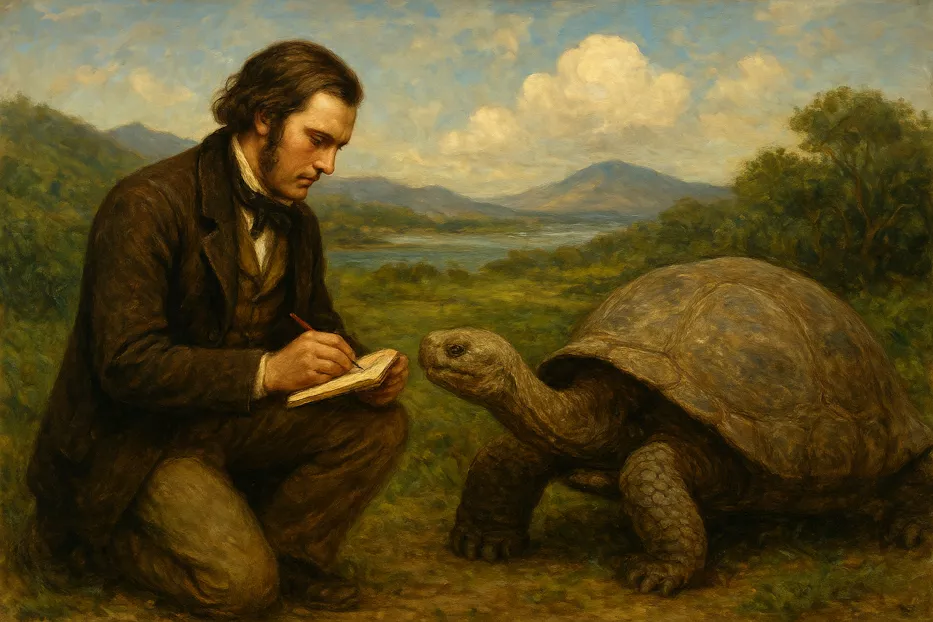
Discover how Charles Darwin’s visit to the Galápagos Islands inspired his theory of evolution by natural selection and shaped modern biology.
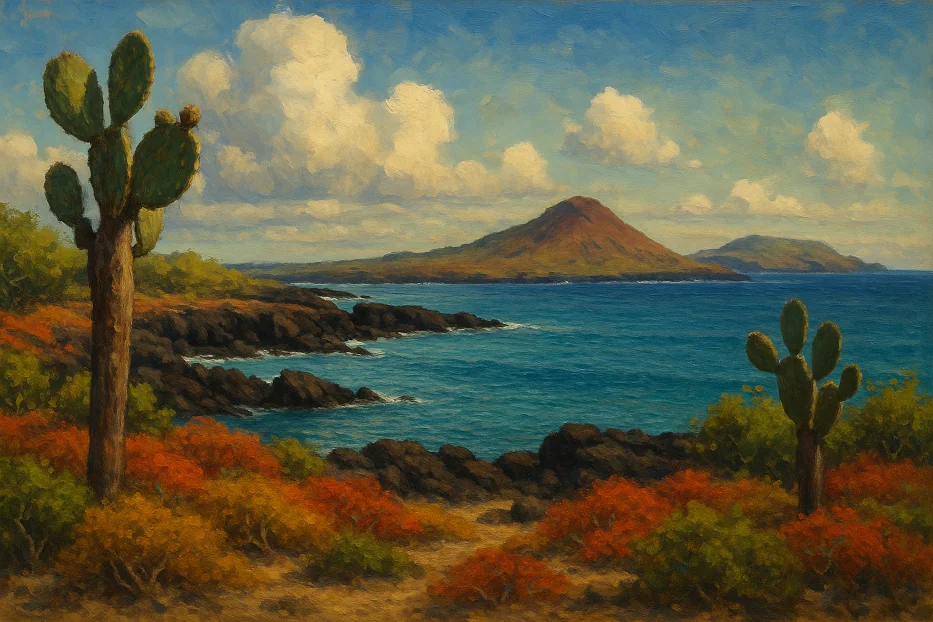
In September of 1835, a young naturalist named Charles Darwin stepped onto the black volcanic shores of the Galápagos Islands. At first glance, the barren rocks and scrubby vegetation seemed lifeless. Yet in the weeks that followed, Darwin found himself surrounded by creatures so strange, so unique, that they would eventually transform how humanity understood life itself.
The Galápagos did not give Darwin his theory of evolution all at once. Instead, they planted questions in his mind—questions that would grow, sharpen, and finally bloom into the concept of evolution by natural selection. For students today, revisiting those islands means walking in the footsteps of one of science’s greatest breakthroughs.
Table of Contents
A Voyage into the Unknown
Darwin was just 22 when he boarded the HMS Beagle in 1831. Officially, his role was to collect plants, animals, and fossils, while the ship’s crew mapped coastlines. Unofficially, the voyage was his chance to turn curiosity into discovery.
For nearly four years, the Beagle traced the edges of South America. Darwin studied giant fossils in Argentina, lush rainforests in Brazil, and the icy landscapes of Tierra del Fuego. But nothing prepared him for the Galápagos—a scattering of volcanic islands 600 miles west of Ecuador.
When the ship anchored there in 1835, Darwin had no idea he was about to step into a living laboratory.
The Puzzle of the Islands
The Galápagos looked young in geological terms—raw, volcanic, still rising from the ocean floor. What struck Darwin was not their geology, though, but their life.
Everywhere he turned, animals seemed oddly out of place, as though they belonged to another world. Giant tortoises lumbered through the brush. Iguanas swam in the sea like reptiles from a science-fiction tale. Birds resembled those he had seen on the mainland, but they were not quite the same.
It was, as Darwin later wrote, “as if one had stepped into another planet.”
Beaks, Shells, and Survival
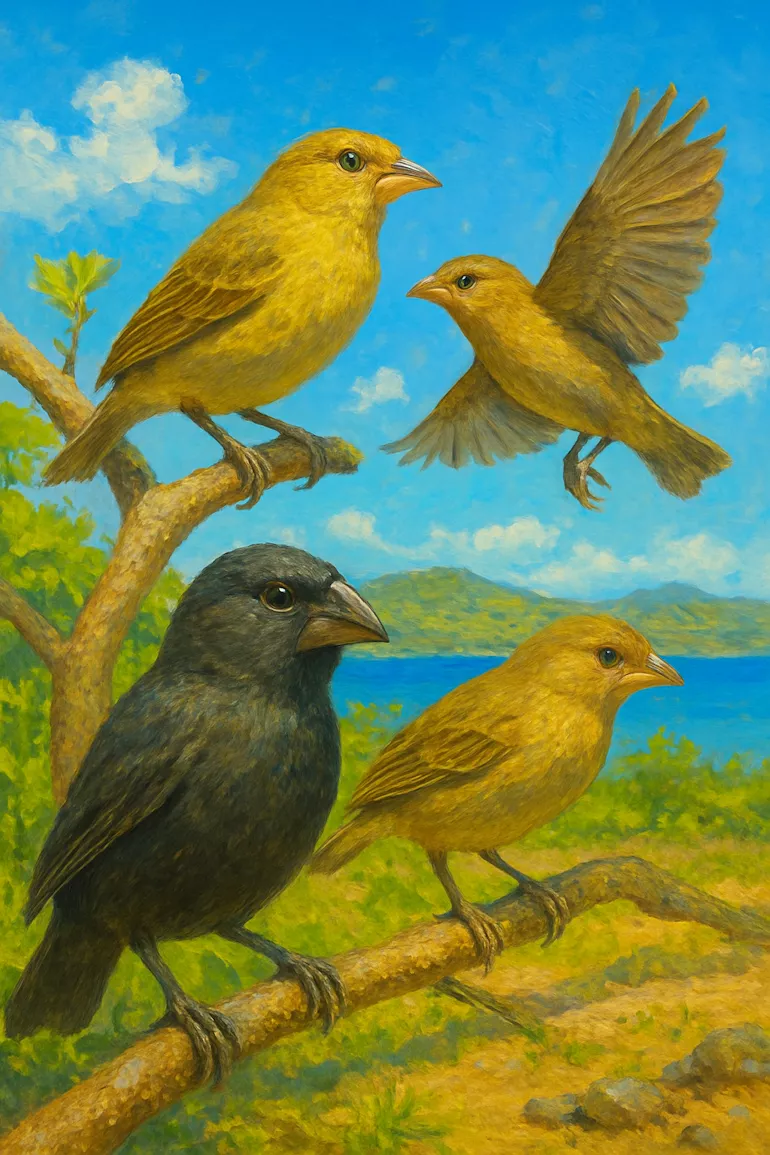
Darwin’s most famous observations came from the finches. At first, he barely noticed them. To him, they were just small, brown birds. But the islanders pointed out something Darwin had missed: on each island, the finches were slightly different.
On an island with hard seeds, finches had heavy, crushing beaks. On another, where insects were plentiful, their beaks were slender and sharp. On cactus-covered islands, the birds carried long, probing beaks perfect for reaching into flowers.
The same pattern appeared in the giant tortoises. Those from wetter islands had domed shells; those from dry islands had “saddleback” shells that allowed them to stretch higher for cactus pads. Local people noticed that tortoises from different islands had distinct shell shapes, a detail that later helped Darwin understand how species adapted to their environment.
To Darwin, these differences hinted at something profound: animals were not fixed. They adapted—their bodies shaped by the challenges of survival.
From Curiosity to Revolution
Back in England, Darwin sorted through his notebooks and specimens. Slowly, the Galápagos puzzle pieces began to fit.
Why would finches differ from island to island if each had been created perfectly? Why would tortoises change their shells depending on geography?
Darwin’s answer was both simple and revolutionary: species change over time. Variations appear naturally within a population. Those individuals with traits best suited to their environment—stronger beaks, taller necks—are more likely to survive and reproduce. Over many generations, these traits spread, while weaker traits disappear.
This process, which Darwin called natural selection, explained not only the finches and tortoises of the Galápagos but also the endless diversity of life on Earth.
Why the Galápagos Were Crucial
Darwin had seen fossils in Argentina and exotic species in Brazil. But nowhere else did he find such a perfect “experiment of nature.”
- The islands were isolated, so species evolved without interference from the mainland.
- Each island offered different conditions—wet, dry, rocky, lush—forcing species to adapt in unique ways.
- The differences were obvious. You didn’t need a microscope to see them; they were written on beaks and shells.
In the Galápagos, the theory of evolution was not abstract. It was alive, walking, crawling, and flying right in front of Darwin.
Evolution in Action
Darwin published On the Origin of Species in 1859, more than two decades after his Galápagos visit. His theory sparked controversy but eventually reshaped biology, medicine, and anthropology.
And the Galápagos remain central to science. In the 20th century, biologists Peter and Rosemary Grant spent decades studying Darwin’s finches. They showed that when droughts struck, birds with stronger beaks survived better, because they could crack tough seeds. Within just a few generations, the average beak size in the population shifted. Evolution wasn’t just a theory—it was measurable, observable, and happening in real time.
Why This Story Matters for Students
Darwin’s journey is more than a chapter in a biology textbook. It’s a story about how knowledge is built.
- It shows the power of observation. Darwin was not armed with high-tech tools—just notebooks, patience, and sharp eyes.
- It highlights the importance of asking questions. Instead of accepting species as unchangeable, he wondered why they varied.
- It demonstrates the impact of ideas. A few weeks on a remote island gave birth to a theory that reshaped science, education, and even philosophy.
The Galápagos Islands remind us that great discoveries can start with simple curiosity.
Direct Ferries
Routes, Schedules, Prices
Ferries in the Americas
A Living Classroom
Today, the Galápagos are a UNESCO World Heritage Site and one of the most protected ecosystems on Earth. Students who travel there—or study them from afar—can still see many of the same species Darwin observed.
Giant tortoises plod slowly through the undergrowth. Marine iguanas dive into the sea. Finches hop from cactus to cactus. The islands remain, as they were in Darwin’s time, a living classroom where the story of evolution unfolds in real time.
Islands That Changed the World
Charles Darwin arrived at the Galápagos as a curious young naturalist. He left with questions that would overturn centuries of thought.
From the beaks of finches to the shells of tortoises, the Galápagos revealed a simple truth: life changes, adapts, and evolves. That truth became the foundation of modern biology and continues to shape how we understand medicine, climate change, and conservation.
For students today, Darwin’s journey is a reminder that science is not about memorizing facts—it’s about noticing patterns, asking questions, and daring to think differently. Sometimes, one voyage, one scientist, and one chain of islands are enough to change the world.