
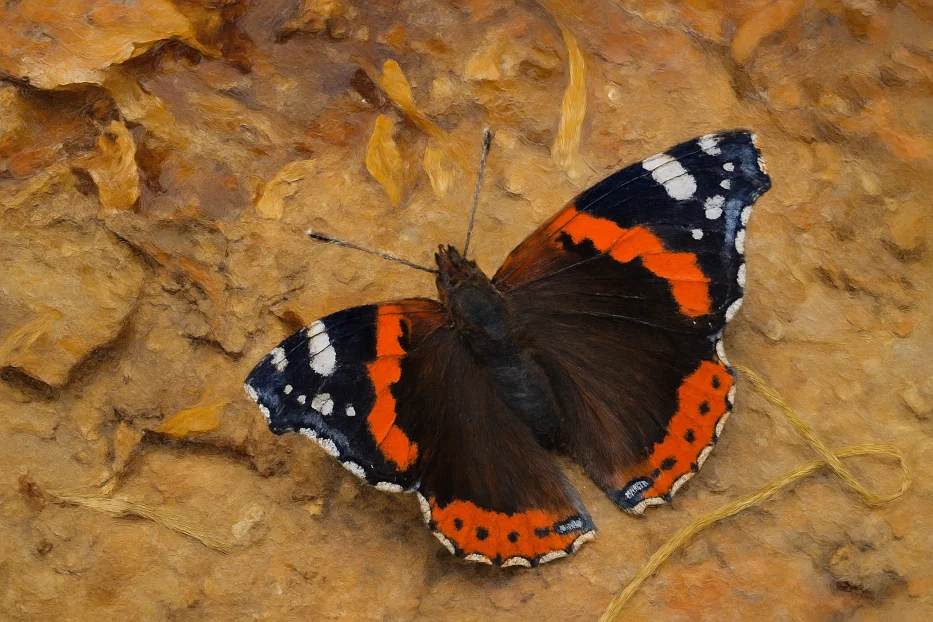
Red Admiral butterflies occasionally reach Iceland in summer, appearing as occasional visitors carried northward during favorable weather conditions.
In warm summers, a few of these small voyagers drift into Iceland’s landscapes, appearing like living embers blown in on southerly breezes. Easily recognized by their striking red bands and inky-black wings, Red Admirals (Vanessa atalanta) are not accidental visitors.
Unlike resident species that overwinter locally, Red Admirals reach Iceland as vagrants — most likely moved north by wind-assisted dispersal rather than by continuous, self-powered flights across the open ocean.
Although Iceland is better known for puffins and Arctic foxes than for insects, the Red Admiral has slowly been carving out a seasonal presence, often surprising locals and visitors who assume such a delicate creature could never reach so far north.
The earliest known record of the admiral butterfly in Iceland dates back to 1901. A century ago, these butterflies were considered rare vagrants, arriving only occasionally when summer winds blew them off course. But in recent decades, sightings have become increasingly common — a trend many scientists attribute to climate change.
Unlike Monarch butterflies in North America, which have well-studied, multi-generational migrations, Red Admirals follow a looser, less predictable pattern. Each spring, they begin moving north from southern Europe and North Africa, propelled by warm air currents and an innate restlessness that seems almost improbable in a creature that weighs less than a paperclip. By the time they reach the British Isles and Scandinavia, many have already traveled over a thousand miles. But some keep going, driven by instinct and perhaps opportunity, until they eventually reach Iceland’s southern coast.
Observers in places like Vestmannaeyjar and the Reykjanes Peninsula sometimes report seeing Red Admirals suddenly appear in gardens or along cliff paths, as if materializing out of thin air. It is more plausible that many are transported part of the way by favorable winds and weather systems; whether any manage a single, continuous open-ocean flight remains unproven and is unlikely for most butterflies. The journey demands great stamina, particularly because nectar sources over the ocean are nonexistent. To sustain themselves, Red Admirals feed heavily on blooming thistles, nettles, and buddleia before setting out.

For many Icelanders, the arrival of these butterflies is an almost poetic reminder of connection — a fragile bridge between their isolated volcanic island and the European mainland. Some locals even consider the Red Admiral a quiet emblem of resilience, a fitting symbol for a country whose own history is marked by endurance in the face of harsh conditions.
Climate researchers and lepidopterists are paying close attention to these changes in migration patterns. Iceland’s summers have grown warmer over the past few decades, and the length of the frost-free season has increased, allowing more insects to survive longer or arrive earlier. Red Admirals are not known to overwinter successfully in Iceland at present; however, researchers note that warmer summers and longer frost-free periods could, in the future, make temporary breeding events more likely — though confirmed, sustained breeding has not been documented yet.
In the meantime, these butterflies remain seasonal visitors, their bright wings flashing against a backdrop of mossy lava fields and midnight sun. For anyone lucky enough to encounter a Red Admiral in Iceland, the sight is a small wonder: a reminder that even in the age of satellites and instant communication, nature still harbors mysteries.
How exactly a single butterfly navigates over such vast distances, without maps or markers, remains partly unexplained. Scientists hypothesize that butterflies may use a combination of cues — sunlight, polarized light, wind direction, and perhaps magnetic information — to orient during movement, but the exact mechanisms for long-distance orientation are still under study. Others argue that favorable winds do most of the work, ferrying the insects almost by accident.
Whatever the mechanism, the result is the same: each summer, a few brave Red Admirals cross the sea and bring a flicker of color to Iceland’s rugged shores. In an era when so many migratory species face decline, their quiet persistence offers an unexpected note of hope and a vivid example of just how far determination can carry even the most delicate of travelers.