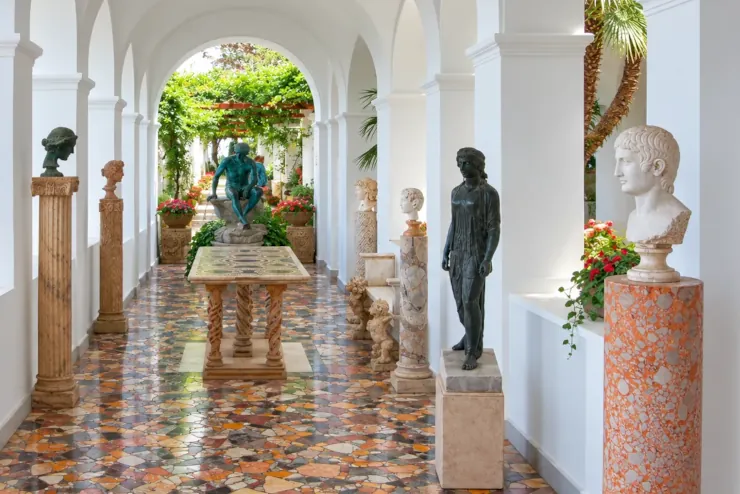
In the late 19th century, a Swedish physician named Axel Munthe fell in love with Anacapri. He bought a small house and vineyard, plus a ruined chapel, high above the sea, and spent years turning them into a home. The result was Villa San Michele, now a museum.
The land already held history. Before Munthe arrived, the site held the remains of a Roman villa, and tradition links it to the Emperor Tiberius, who also had a clifftop palace, Villa Jovis, on the other side of the island. Munthe used what he found. Fragments of ancient columns, floors and statues became part of the house and garden.
Munthe also collected antiques from elsewhere. The best-known piece is a red granite sphinx from Egypt, which is more than 3,000 years old. It sits on a terrace and looks out over the sea. The house also holds a marble bust traditionally identified as Tiberius, a head of Medusa, and a table decorated with mosaic.
Munthe wanted a house open to the sun, the wind and the sound of the sea, like a Greek temple. The building rises on several levels. A long covered walkway with columns leads to a round viewpoint that looks across the Bay of Naples.
The garden includes Mediterranean plants and a small medieval chapel that Munthe restored himself. Today the villa is a museum, and it also hosts concerts and cultural events.
In 1929, Munthe published a memoir called The Story of San Michele. It described how he first visited the island and built his house, and it was an immediate success around the world. It has been translated into many languages and reprinted many times.
Building the villa on Capri was a big local effort. The village was poor, and neighbours did much of the work. Much of the material came up the Phoenician Steps, the ancient stairway from the port, carried by people and donkeys.