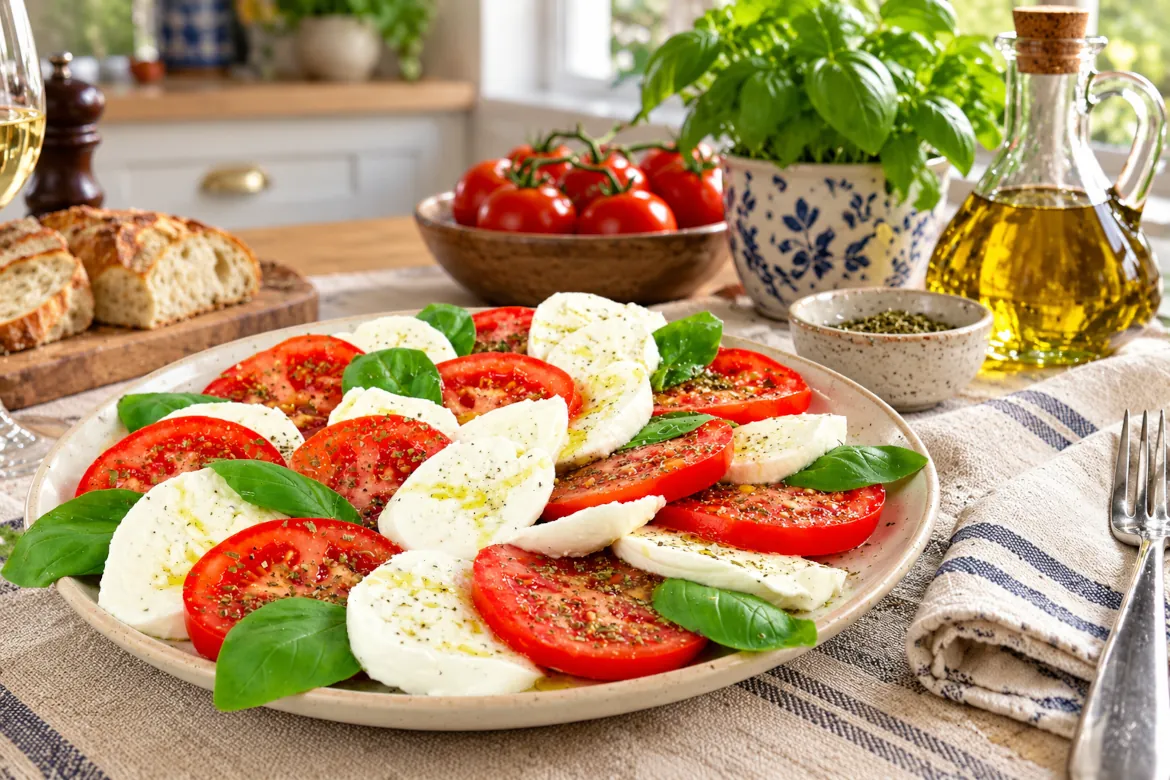
Tomato, mozzarella and basil: the caprese salad, known in Italian as insalata caprese, has only three main ingredients, and together they show the colours of the Italian flag.
This page contains affiliate links, which may earn us a small commission.
All three, and the olive oil that dresses them, are well-known products of the Campania region, where Capri lies. The name means “from Capri”, but the story of who first made it, and when, is uncertain.
The most repeated story places the salad at the Grand Hotel Quisisana in Capri in the early 20th century. In this version, the hotel served it during an event linked to Futurism, an Italian art movement that admired speed and modern life.
The movement’s leader, the poet Filippo Tommaso Marinetti, attacked pasta. In his Manifesto of Futurist Cooking, he argued that it made Italians heavy and slow. According to the story, the kitchen served a plate of raw tomato, mozzarella and basil instead. The same hotel was a favourite of Friedrich Alfred Krupp, the steel magnate behind Via Krupp, a famous cliff path nearby.
Other stories are simpler. In one, a patriotic builder on Capri filled his lunch sandwich with tomato, mozzarella and basil to echo the flag. In another, King Farouk of Egypt asked for something light on the island in the mid-20th century and was served the same three ingredients.
None of the three stories can be proven, and even the exact year of the Quisisana dinner is disputed, with different accounts placing it anywhere from the 1920s to the 1930s. One Italian food magazine notes that the dish does not come from the island’s older cooking traditions at all, despite its name pointing to Capri.
What is clear is how the dish spread. It became a staple in Capri’s hotels and gained wider fame as the island attracted international visitors in the middle of the 20th century. Traditionalists say the classic version needs only olive oil, salt and sometimes a pinch of dried oregano, without balsamic vinegar.