
The Doge’s Palace has a long history. Venice decided to build the first palace in the 9th century, but nothing of it remains.
The Gothic building that stands today mostly dates from the 14th and 15th centuries. The doge, the leader of the Republic of Venice, lived there. It was also the place where the government worked. In fact, courts, councils and offices all sat under one roof.
First, visitors enter this large building next to St Mark’s Basilica. The basilica used to be the doge’s chapel. Then visitors can follow the path that officials, judges and prisoners once took.
This page may contain affiliate links.
The Giants’ Staircase and the Golden Staircase
Two large statues, Mars and Neptune, guard the Giants’ Staircase in the inner courtyard. They stand for the land and sea power of Venice. For centuries, Venice crowned each new doge at the top of these stairs.
Inside the palace, the Golden Staircase leads up to the state rooms. Gold and white stucco also decorates its walls and ceiling. Visitors climb it today to reach the upper floors, where the doge and the councils once met.
The largest room in the Doge’s Palace
The Hall of the Great Council was the meeting room of Venice’s noble families. These families took part in governing the Republic, and they also helped choose the doge. On one wall hangs Paradise by Tintoretto, one of the largest oil paintings in the world.
Around the top of the room, portraits of the doges run in a long line. A black-painted drape marks the spot where Doge Marino Faliero’s portrait would normally hang. The Republic executed him for treason in 1355.
Lion’s mouths in the Doge’s Palace
In several places around the palace, there are carved stone openings called bocche di leone, or lion’s mouths. Citizens could post a written report about suspected crimes into one of them. Then officials could investigate the report.
From the courtroom to the cell
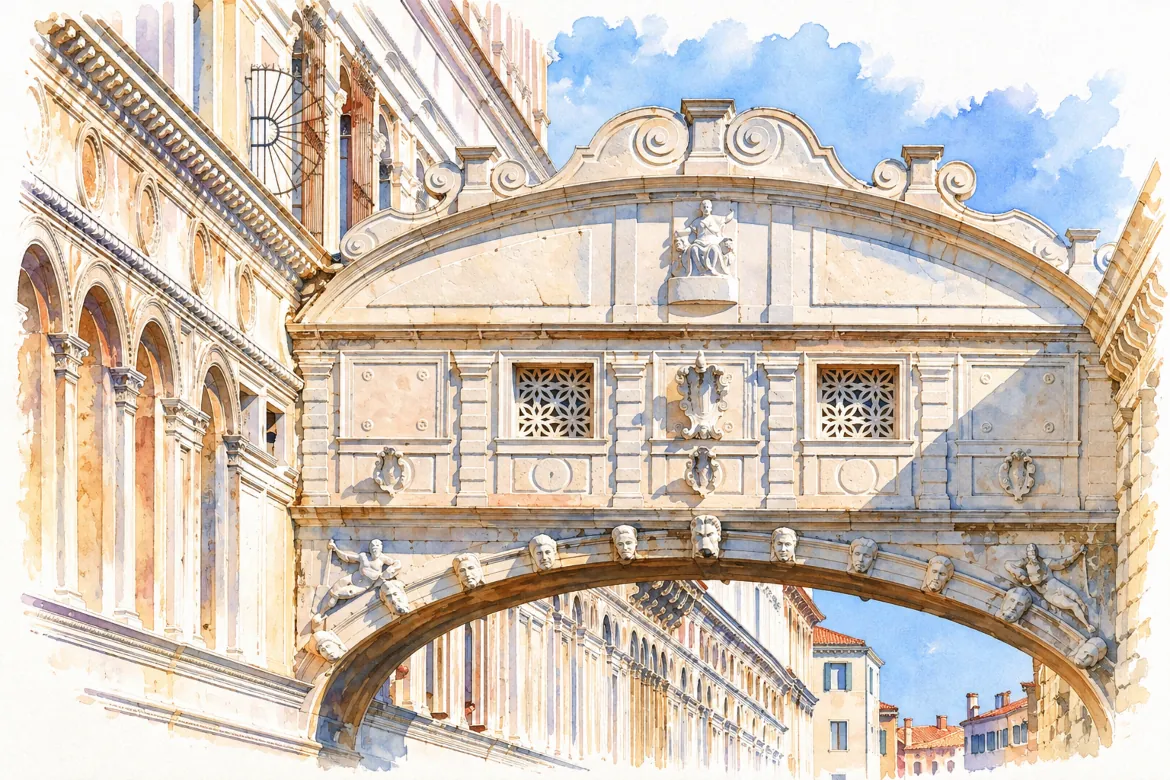
The Bridge of Sighs is an enclosed stone bridge that crosses a canal beside the palace. It connects the interrogation rooms in the palace to the New Prisons. The city built these prisons in the late 16th and early 17th centuries.
However, the name of the bridge became popular only in the 19th century. At that time, writers imagined prisoners sighing as they looked at the lagoon for the last time.
Inside the palace, older prison cells lay in two places. First, the pozzi, “the wells”, were damp, dark cells on the ground floor. A narrow door in the courtyard still leads to them. Second, the Piombi, “the Leads”, sat under the roof and got their name from the lead covering on the roof.
Builders made their cells from wooden partitions with iron sheets nailed to them. The Council of Ten imprisoned people there, many of them accused of political crimes. Yet the conditions were better than in the pozzi.
The Chancellery, the torture chamber and Casanova’s cells
Behind the main halls, a series of smaller rooms links the Republic’s records to its prisons. For example, the Secret Chancellery has cabinets that once stored public and secret documents of the Republic’s magistrates. Beyond it, a torture chamber connects directly to the prisons.
Then a passage leads on to the Piombi. There, the writer Giacomo Casanova stayed in two different cells, and both are now reconstructions. In 1756, he escaped from the Piombi by breaking through the ceiling and climbing onto the roof.