
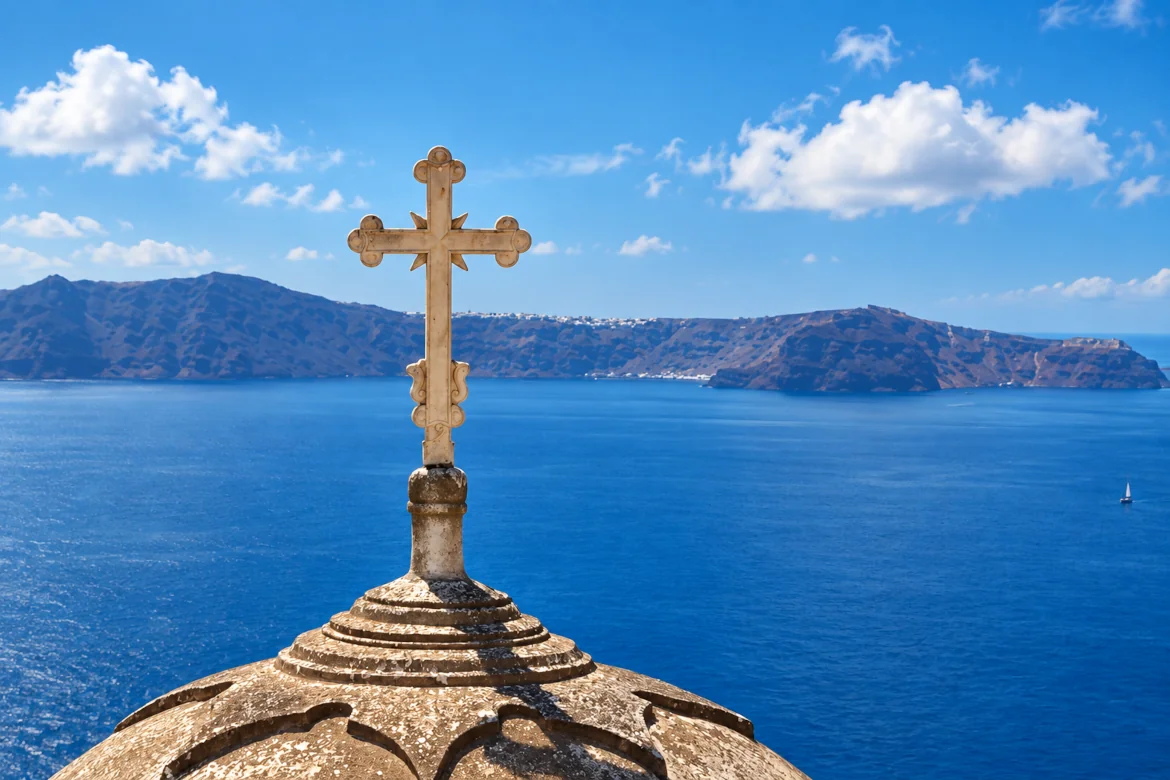
A ferry to Santorini is one of the most popular ways to reach the island, especially for travelers who are island-hopping around Greece.
This page contains affiliate links, which may earn us a small commission at no extra cost to you.
What makes ferry travel different from flying is that the “best” route genuinely depends on where you’re starting from and what you’re willing to trade off between speed and price, so this article walks through what to actually expect from the main routes, rather than just listing them. The prices and details below are based on Direct Ferries.
The Port of Santorini
Santorini has one main ferry port, known as the New Port, which handles up to 265 sailings a week, making it one of the busiest island ports in the Cyclades.
Several ferry companies operate from this port, including Blue Star Ferries, SeaJets, Golden Star Ferries, Cyclades Fast Ferries, and Hellenic Seaways. Because some companies share the same routes, it is worth comparing them rather than booking the first option that appears, since price and journey time can differ noticeably between operators on the same route, as the numbers below show.
Choosing a Route: Speed Versus Price
Coming from Athens (Piraeus) is the most common way to reach Santorini for travelers arriving from outside Greece, since it connects directly to the capital’s international airport.
It is also one of the busiest routes, with around 30 sailings per week combined across operators, but the journey time varies enormously depending on which one you pick: anywhere from 5 hours 35 minutes on the fastest option to 10 hours 35 minutes on the slowest.
This is the clearest example of the general trade-off on Greek ferries: faster ferries save you most of a day, but usually cost more, while a slower overnight-style crossing can work well if you don’t mind arriving late or would rather save the money.
Routes between Santorini and the other Cycladic islands tend to be faster across the board, simply because the distances are shorter.
From Mykonos, about 30 sailings run weekly, with the fastest crossing taking around 2 hours 30 minutes; from Paros, roughly 30 weekly sailings range between 1 hour 50 minutes and 3 hours 15 minutes; and from Naxos, around 32 sailings weekly include an option as fast as 1 hour 25 minutes.
The fastest connection to Santorini overall is from Ios, where the quickest ferry takes as little as 40 minutes, making it a realistic option even for a day trip rather than a full relocation.
Coming from Crete (Heraklion) sits in between: about 7 sailings a week, with journey times between 1 hour 35 minutes and just over 3 hours, depending on the operator. This route is worth knowing about specifically if you are combining Santorini with a longer Crete stay, since it avoids backtracking through Athens.
What Ferries Actually Cost
Prices vary by route, operator, and how far in advance you book, so the numbers below are a guide rather than a guarantee.
A ticket from Paros to Santorini costs around €128 on average, while Mykonos to Santorini averages about €176, both excluding booking fees. At the opposite end, the cheapest ferry connection to Santorini overall is from Sikinos, where tickets can cost as little as €5.
What this tells you practically is that price does not track distance in a simple way; it depends heavily on which islands are connected by which operators, and how much competition exists on a given route.
Rather than assuming a nearby island will always be the cheaper option, it’s worth checking prices for your specific route directly, since they can shift closer to your travel dates.
Bringing a Car or a Pet
If you are planning a road trip through the Greek islands rather than relying on public transport at each stop, it helps to know that car ferries to Santorini do exist, offered by Blue Star Ferries, Cyclades Fast Ferries, SeaJets, Hellenic Seaways, and Golden Star Ferries.
Pets are also allowed on board with Blue Star Ferries, SeaJets, Hellenic Seaways, and Golden Star Ferries, though it is worth confirming the specific policy directly with the operator, especially if you are traveling with a service animal, since rules can vary by ship and by season.
Island Hopping from Santorini
Santorini is often used as one stop on a longer island-hopping trip rather than a final destination, and the short crossing times to nearby islands are a big part of why: Ios (about 35 minutes), Naxos (about 1 hour 15 minutes), Paros (about 1 hour 30 minutes), Crete/Heraklion (about 1 hour 45 minutes), Mykonos (about 2 hours), and Milos (about 2 hours) are all realistic same-day connections.
This is different from flying between islands, where short hops are rarely practical once you account for airport transfers, so for travelers building a multi-island itinerary, the ferry network is usually the more flexible option, provided the schedule cooperates.
Booking Your Ferry Ticket
Ferry schedules in Santorini can change throughout the year, and sailings usually increase during the high season. Because of this, it is worth checking the latest schedule shortly before finalizing your travel plans rather than relying on figures from months earlier, since availability and pricing shift as the season approaches.
Booking through Direct Ferries allows you to compare routes, operators, and prices in one place, and to see live availability for your chosen dates.
A Few Practical Notes
If your trip includes several islands, it is worth building some flexibility into your itinerary, since ferry timetables can be tight, especially outside the busy summer season when sailings are less frequent.
Direct Ferries offers flexi tickets that make it easier to change plans if something shifts, along with live ship tracking and real-time updates, so you have visibility into your booking as your travel date approaches, rather than having to guess whether a sailing is running on time.