
 Islands Around

Wales rewards the traveler who slows down and picks a small town to wander through. What makes a Welsh town beautiful, exactly? It’s rarely one single thing.
It’s the way a row of houses is painted to match the water in front of it, the way a castle wall still curves around a street after seven hundred years, the way a valley or an estuary seems to have been placed there on purpose, just to frame the view.
Each of the seven towns below earns its place for a different visual reason, from color to setting to sheer architectural completeness, and each one, seen for the first time, tends to stop people mid-step.
This page contains affiliate links, which may earn us a small commission.
Hay-on-Wye

Walk into Hay-on-Wye on an ordinary Tuesday and the first thing you notice isn’t a landmark; it’s the texture. Ivy climbs over stone shopfronts, honesty-box bookshelves spill out onto the pavement, and the whole town has the soft, slightly crumbling look of something that’s been left to age gracefully rather than restored into stiffness.
The River Wye curls below the hillside, and from certain angles the town seems to be quietly sliding down toward it, rooftops and chimneys stacked at gentle angles. It’s a beauty built from clutter done well: over twenty bookshops packed into narrow lanes that smell of paper and dust, with nearly 2,000 people to keep it all running.
The town became known as the world’s first “book town” in the 1960s, and every May the Hay Festival, once called “the Woodstock of the mind” by Bill Clinton, briefly floods the streets. But it’s the ordinary days that show off the town best, when there’s nothing to do but notice how the light falls on old stone.
Beaumaris

Most castle ruins look broken. Beaumaris looks paused.
Its concentric walls and towers, begun in 1295 by King Edward I, were designed with such precise, mirrored symmetry that the castle reads as elegant rather than damaged, even though money ran out before it was finished. Its moat is still full, and swans drift past the walls as if none of the last seven centuries happened.
Stand on the Victorian pier at sunset and the whole scene widens: cold sea air, Snowdonia’s peaks rising blue-grey across the Menai Strait, boats slipping out toward Puffin Island.
The town itself, home to over 1,100 people, wraps around this in unhurried Georgian terraces and old inns, all low rooflines and quiet color, never competing with the castle or the mountains for attention.
Conwy

There’s a particular kind of beauty in something built for war that ended up looking this graceful.
Conwy‘s town walls, 0.8 miles of stone raised between 1283 and 1287 with 21 towers and three gatehouses, still ring the entire town, so intact that you can walk almost their full circumference and watch the castle loom over every rooftop from nearly any angle.
Seen from across the estuary, the effect is almost theatrical: turreted walls, a castle silhouette behind them, and three very different bridges lined up below like a small timeline of engineering, an 1826 suspension bridge, an 1848 tubular railway bridge, and a 1958 road bridge.
Squeeze through the alleys inside, and you’ll find the so-called smallest house in Great Britain on the quay, barely wider than a doorway, plus locals nicknamed “Jackdaws,” after the black birds nesting on the battlements, going about a town of just over 4,000 that somehow still feels medieval rather than preserved.
Tenby

Tenby doesn’t need context to be beautiful. It’s one of the most photographed harbors in Wales for a simple reason: the houses are pink, yellow, blue, and cream, stacked in tidy Georgian rows that face the water like they’re posing for it.
That color tradition only began in the 19th century, when the town council started requiring homeowners to paint their properties, and the result is a waterfront that looks almost illustrated.
Around 4,700 people live inside walls that date to the 13th century, later strengthened by Jasper Tudor, and you still enter the old town through the Five Arches gatehouse, a weathered stone barbican that’s outlasted seven centuries of war and weather.
Beyond the walls, pale sand runs for nearly two miles toward Penally. It’s strange, and a little funny, that a town built for defense ended up this soft and cheerful, but that contrast is a big part of why it works visually.
Aberaeron

Most Welsh coastal towns grew slowly and messily, shaped by centuries of fishing.
Aberaeron looks different because it was different: in 1805, a local clergyman, Reverend Alban Thomas Jones Gwynne, built the entire harbor from scratch, hiring an architect to lay out a formal grid of streets and fill it with uniform Regency terraces in soft, cheerful colors.
The result is a rare thing: a town that looks composed rather than accumulated, every façade in matching proportion, every color chosen rather than inherited.
Walk the quay and the whole town reads like a single coordinated idea, home today to nearly 1,300 people. It’s the kind of beauty that comes from intention rather than time, a harbor town that was designed to look exactly like this from the very start.
Crickhowell
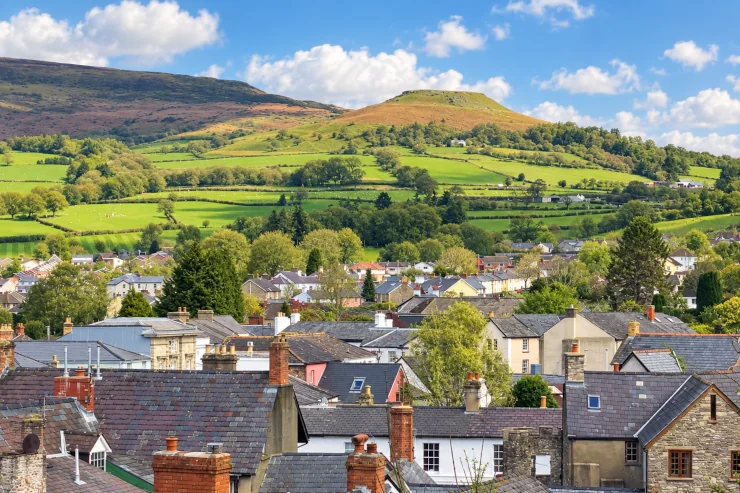
Crickhowell‘s beauty isn’t really about the town itself; it’s about what the town sits inside. The Black Mountains meet the eastern Brecon Beacons here, and the light over them shifts constantly, changing the color of the hills behind the rooftops through the course of a single afternoon.
At the center of it all is a slightly eccentric old stone bridge over the River Usk with a mismatched arch count on each side (12 on one, 13 on the other), the result of an 1810 widening, that somehow feels more charming for being imperfect.
Above the roughly 2,000 residents, the grassy mound of a Norman castle ruin offers one of the best places to just sit and watch the hills change.
J. R. R. Tolkien once said the name Crickhowell inspired “Crickhollow” in his fictional Shire, which fits: this is a town that feels like it belongs at the edge of a story, green slopes rolling almost to the rooftops and a slow river running underneath it all.
Laugharne

Laugharne‘s beauty is quiet, almost withheld. It’s a town of mudflats, tides, and long views rather than color or spectacle.
The Boathouse, where the poet Dylan Thomas lived with his family from 1949 until he died in 1953, sits cliffside above the Taf estuary, looking out toward Sir John’s Hill, and it’s easy to see why the view held his attention for four years: the light on the water shifts constantly, and the whole scene stays essentially unpeopled and still.
A short walk away, his plain wooden writing shed later inspired Roald Dahl to build his own. Over 1,000 people live here today, alongside a 12th-century castle and rows of Georgian townhouses, but the real draw is the mood: grey stone, a wide, changeable sky, and water that never quite sits still.